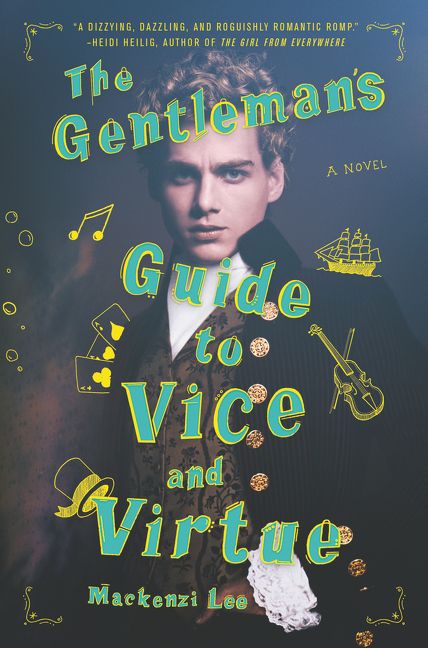
The Gentleman's Guide to Vice and Virtue by MacKenzi Lee
“On the morning we are to leave for our Grand Tour of the Continent, I wake in bed beside Percy. For a disorienting moment it’s unclear whether we’ve slept together or simply slept together.”
So begins this rollicking romp in 18th Century Europe. Monty is an English gentleman, but he’s also a playboy, regularly getting into compromising positions with both girls and boys. He’s leaving on a grand tour of Europe with his sister, Felicity, and his best friend (and secret crush), Percy. Monty is determined to have one last hurrah before his father imprisons him in gentlemanly adult responsibilities, like marriage and overseeing the estate. He has barely started his adventures in France when, at the Palace of Versailles, he gets caught naked with a courtesan and flees out the window, but not without stealing a pretty box of the Duke of Bourbon’s out of spite. They learn just how valuable this box is when highwaymen run them down the next day. Now, Monty, Percy, and Felicity appear to possess the secret to immortality and must decide what to do with it and manage to stay alive to do it.
This is at once a hilarious, scandalous, and thrilling book that may also surprise you with poignant moments. It was pure enjoyment the whole way through. Lee’s writing was a delight—snarky and funny one moment, tender and poetic the next. Percy and Felicity are lovable without question, while Monty is so selfish and irresponsible, it takes a while (and some growth) before I came to love him as well. It may seem a bit fluffy because of the light tone and humor sprinkled throughout, but Lee includes some pretty serious and ambitious ground: grand tours of Europe (which was a common practice for the upper classes at the time), epilepsy at a time when people had no real understanding of it, ditto for homosexuality, physical abuse, feminism, alcoholism, racism, shall I continue? And yet it all works together. She explains the historical context for many issues covered in the book in her note. Are there anachronisms? Is it a bit rosy to be realistic? Probably. Did I care? Not so much. This book made me laugh, blush, gasp, and fall in love. I warn you, it’s a bit mature for a teen book; there’s a fair amount of raunch, but alas, I absolutely loved it.
Showing posts with label historical fiction. Show all posts
Friday, December 22, 2017
Sunday, June 21, 2015
Recent Read: The War That Saved My Life
The War That Saved My Life by Kimberly Brubaker Bradley
Ada was born with a club foot and it was never repaired. Her abusive mother keeps her locked up in their apartment, calling her a monster because of her ugly foot. When Ada’s little brother Jamie has the opportunity to be evacuated into the country to escape the bombs of an imminent World War II, Ada sneaks away with him.
They are delivered to Oxford-educated Susan and her large, clean, country house. It’s a completely different world for the children—a world with baths, new clothing (including their very first underwear), food, and green grass. And even though it’s an enormous improvement over their home, it’s unfamiliar, and they find themselves overwhelmed and homesick. Ada struggles with the effects of her cruel upbringing. Kindness and acceptance are unfamiliar to her, and sometimes her panic and fear overwhelm her. She finds solace in Susan’s pony, Butter. Susan herself finds it difficult to care for the children, as she is suffering a deep depression after the loss of Becky, the woman she lived with and loved (the true nature of their relationship is for readers to decipher between the lines). The children do not see depression, but a woman who stays in bed all day long, sometimes mutters about not wanting or asking for children, and declares herself to be “not nice.”
Set against the backdrop of an escalating World War II, all three of them start to heal as they care for and come to love one another.
There are so many elements that I found interesting on their own, and they all came together to tell this lovely story. Living in Kent, the war touches their lives in real and oftentimes dramatic ways. The therapeutic comfort of working with horses rang true (I loved hearing things like when Ada feels a “whoosh of breath on [her] neck” ♥) Jamie also has his own challenges to overcome. I loved the authenticity of it all. Each of them finds meaning and purpose as they go beyond their insular worlds to care for one another and get involved in the war effort. Ada’s troubles are not fixed with a simple hug. She suffers long term effects from her mother’s abuse that take time and effort to overcome. And yet, Ada is as instrumental in saving Susan, as Susan is in saving her.
To top it off, this was one of those books that is wonderfully easy to read. I just opened it up and fell into it. And that was that. Before I knew it, it was over. I loved this one!
Ada was born with a club foot and it was never repaired. Her abusive mother keeps her locked up in their apartment, calling her a monster because of her ugly foot. When Ada’s little brother Jamie has the opportunity to be evacuated into the country to escape the bombs of an imminent World War II, Ada sneaks away with him.
They are delivered to Oxford-educated Susan and her large, clean, country house. It’s a completely different world for the children—a world with baths, new clothing (including their very first underwear), food, and green grass. And even though it’s an enormous improvement over their home, it’s unfamiliar, and they find themselves overwhelmed and homesick. Ada struggles with the effects of her cruel upbringing. Kindness and acceptance are unfamiliar to her, and sometimes her panic and fear overwhelm her. She finds solace in Susan’s pony, Butter. Susan herself finds it difficult to care for the children, as she is suffering a deep depression after the loss of Becky, the woman she lived with and loved (the true nature of their relationship is for readers to decipher between the lines). The children do not see depression, but a woman who stays in bed all day long, sometimes mutters about not wanting or asking for children, and declares herself to be “not nice.”
Set against the backdrop of an escalating World War II, all three of them start to heal as they care for and come to love one another.
There are so many elements that I found interesting on their own, and they all came together to tell this lovely story. Living in Kent, the war touches their lives in real and oftentimes dramatic ways. The therapeutic comfort of working with horses rang true (I loved hearing things like when Ada feels a “whoosh of breath on [her] neck” ♥) Jamie also has his own challenges to overcome. I loved the authenticity of it all. Each of them finds meaning and purpose as they go beyond their insular worlds to care for one another and get involved in the war effort. Ada’s troubles are not fixed with a simple hug. She suffers long term effects from her mother’s abuse that take time and effort to overcome. And yet, Ada is as instrumental in saving Susan, as Susan is in saving her.
To top it off, this was one of those books that is wonderfully easy to read. I just opened it up and fell into it. And that was that. Before I knew it, it was over. I loved this one!
Friday, June 7, 2013
Recent Read: The Queen of Water
At age 7, Virginia, a poor indigenous girl from Ecuador, is taken from her Andean village to the city to work for an upper class family as a maid. Her life resembles that of a slave more than that of a maid. Her mistress beats her and insults her regularly, calling her racial slurs for be an indigena. She has no contact with her family and is told they don't want to see her. But she is determined to become educated and find a way out. In this true story of a stolen daughter, we follow Virginia as she learns to survive and overcome through education, intelligence, and perseverance.
In the Queen of Water, author Laura Resau succeeds in depicting so many complex aspects of Virginia's story--conflicting emotions, confused identity, a sort of Stockholm syndrome, and the cultural tensions within Ecuador. It's hard to read at times, but there are moments of humor and hope even in the darkest of times. I found the conflict Virginia faces as she tries to find her place in the world after being cut off from her family, raised in a mestizo (upper-class) home, and taught to revile her heritage compelling and heartbreaking. But Virginia is an incredible person--intelligent, ambitious, innovative, hard working, and always hopeful.
Resau explains how she met Maria Virginia Farninango and heard her story in the author's note. She says that despite the heartbreaking and sometimes disturbing nature of Farinango's experience, she told it with "laughter, spunk, and . . . heart-swelling triumph." I think Resau successfully captured those qualities in her narrative.
It's an inspiring book. And it's another one of those books that taught me about something I didn't even know happened (at least not as recently as the 80s!!). I appreciate books like this one that not only tell a good story, but educate me. Overall, I would highly recommend this because of the story alone.
This is not, however, a book for reluctant readers. It felt a little long in places. Even though it didn't feel like space was wasted, it probably could have been a bit tighter.
You can see photos of the real Maria Virginia (and see photos of Ecuador and hear stories of the author's experience there) here. Oh, and that cover photo is an ever-so-slightly altered photo of Maria Virginia herself!
In the Queen of Water, author Laura Resau succeeds in depicting so many complex aspects of Virginia's story--conflicting emotions, confused identity, a sort of Stockholm syndrome, and the cultural tensions within Ecuador. It's hard to read at times, but there are moments of humor and hope even in the darkest of times. I found the conflict Virginia faces as she tries to find her place in the world after being cut off from her family, raised in a mestizo (upper-class) home, and taught to revile her heritage compelling and heartbreaking. But Virginia is an incredible person--intelligent, ambitious, innovative, hard working, and always hopeful.
Resau explains how she met Maria Virginia Farninango and heard her story in the author's note. She says that despite the heartbreaking and sometimes disturbing nature of Farinango's experience, she told it with "laughter, spunk, and . . . heart-swelling triumph." I think Resau successfully captured those qualities in her narrative.
It's an inspiring book. And it's another one of those books that taught me about something I didn't even know happened (at least not as recently as the 80s!!). I appreciate books like this one that not only tell a good story, but educate me. Overall, I would highly recommend this because of the story alone.
This is not, however, a book for reluctant readers. It felt a little long in places. Even though it didn't feel like space was wasted, it probably could have been a bit tighter.
You can see photos of the real Maria Virginia (and see photos of Ecuador and hear stories of the author's experience there) here. Oh, and that cover photo is an ever-so-slightly altered photo of Maria Virginia herself!
Friday, March 29, 2013
Recent Read: The Unfortunate Son
Set in 16th century France, this story is about Luc, a boy born with only one ear. His father rejects him, as do many others who see his deformity. But when he meets a fisherman named Pons and his sister and niece, Luc is embraced and loved as part of the family. He's gifted at fishing and becomes an apprentice. But his happiness is short lived. At sea one day, a ship of pirates kidnap Luc and sell him as a slave in North Africa. Villagers think of the boy as terribly unlucky--one ear, a drunkard father, stolen by pirates--but Pons always called Luc his good-luck boy. Will Luc survive and overcome the misfortune that's befallen him, or will his life prove unlucky as the villagers say?
The Unfortunate Son by Constance Leeds was wonderful. The writing is top-notch. The historical setting is meticulously researched, and Leeds gives the reader an interesting look into 16th century France. But it's not an exciting swashbuckling tale, as the kidnapped-by-pirates part might suggest. He doesn't even get kidnapped until almost 100 pages in. That's not to say that it's boring. There's a little bit of a mystery involving Luc's parentage, there's the hope/effort to reunite Luc with his adopted fisherman family, there's the quest for survival in a new place as a slave, etc. Leeds creates meaningful relationships with fully fleshed-out characters. I became invested in these people and their stories--I didn't want to say goodbye. I also loved the themes Leeds delved into (and how she addressed them)--destiny, luck, attitude, perception, as well as forgiveness. Does Luc's ear make him lucky or unlucky? Is Luc's fortune determined by exterior circumstances or his own attitudes and decisions?
(There is a mention of eunuchs--it's for a purpose, but I would imagine that some parents would not want to explain the what and why to their children.)
The Unfortunate Son by Constance Leeds was wonderful. The writing is top-notch. The historical setting is meticulously researched, and Leeds gives the reader an interesting look into 16th century France. But it's not an exciting swashbuckling tale, as the kidnapped-by-pirates part might suggest. He doesn't even get kidnapped until almost 100 pages in. That's not to say that it's boring. There's a little bit of a mystery involving Luc's parentage, there's the hope/effort to reunite Luc with his adopted fisherman family, there's the quest for survival in a new place as a slave, etc. Leeds creates meaningful relationships with fully fleshed-out characters. I became invested in these people and their stories--I didn't want to say goodbye. I also loved the themes Leeds delved into (and how she addressed them)--destiny, luck, attitude, perception, as well as forgiveness. Does Luc's ear make him lucky or unlucky? Is Luc's fortune determined by exterior circumstances or his own attitudes and decisions?
(There is a mention of eunuchs--it's for a purpose, but I would imagine that some parents would not want to explain the what and why to their children.)
Saturday, February 2, 2013
Recent Read: Out of the Easy
Josie is the daughter of a prostitute. But despite her growing up among prostitutes in a New Orleans brothel, she's smart, loves literature, and sets her sights on a life outside of the Big Easy. She dreams of going to Smith College after meeting a student there, but can't see how she'll ever be accepted or have enough money. And even as she decides to try, a wealthy tourist's suspicious death threatens to disrupt her her friends, family and future.
There's a little bit of everything in Ruta Sepetys's second novel: mystery, historical setting, romance, the criminal underbelly of New Orleans, and a valiant girl striving for something better. But despite the murder and prostitution (among other things), this is no titillating thriller. Instead, Out of the Easy is about character, decisions, and relationships (with a little scandal thrown in). Sepetys has created interesting, likable characters, and she includes a lot of historical detail. Even though it's not your typical page-tuner, there's a lot going on. I'm so pleased to find that Sepetys is just as good the second time around (if you haven't read Between Shades of Gray--not to be confused with 50 Shades of Grey--you should get it). She seems to have an attraction to the human spirit.
Out of the Easy by Ruta Sepetys
Philomel
Releases February 12, 2013
review based on advanced reader copy--uncorrected proof
Review based on uncorrected advanced galley.
There's a little bit of everything in Ruta Sepetys's second novel: mystery, historical setting, romance, the criminal underbelly of New Orleans, and a valiant girl striving for something better. But despite the murder and prostitution (among other things), this is no titillating thriller. Instead, Out of the Easy is about character, decisions, and relationships (with a little scandal thrown in). Sepetys has created interesting, likable characters, and she includes a lot of historical detail. Even though it's not your typical page-tuner, there's a lot going on. I'm so pleased to find that Sepetys is just as good the second time around (if you haven't read Between Shades of Gray--not to be confused with 50 Shades of Grey--you should get it). She seems to have an attraction to the human spirit.
Out of the Easy by Ruta Sepetys
Philomel
Releases February 12, 2013
review based on advanced reader copy--uncorrected proof
Review based on uncorrected advanced galley.
Wednesday, December 19, 2012
Recent Read: Aristotle and Dante Discover the Secrets of the Universe
Aristotle feels angry and out of place. He's frustrated that a wall seems to keep him from understanding his quiet Vietnam vet father. He doesn't fit in with other guys--or people for that matter. His family never says a word about his brother who's in prison. He's a loner, but he satisfied with that, until he meets Dante, another Meixan American kid the same age, who teaches Ari to swim. They bond over the shared academic ridiculous sound of their names. Dante is different--different from Ari, different from everyone he's ever met. Dante's articulate, artistic, effusive, happy, open, affectionate. Aristotle doesn't realize how much will change when he opens his life to Dante in this story about family, identity, and love.
Aristotle and Dante Discover the Secrets of the Universe by Benjamin Alire Sáenz was very nicely done. Simple, direct, thoughtful narration from one of the most meditative narrators I've encountered in YA lit. It's lyrical and lovely, and I love the way it touches on so many meaty themes--family, identity (from many angles: race, culture, sexual orientation, gender, etc), relationships, violence, etc. And I think the short chapters made it very readable. It's historical fiction because it takes place in the 80s, but it doesn't feel like historical fiction. It could just as easily be contemporary, and I wonder if the 80s setting might have been chosen because attitudes toward homosexuality weren't as accepting back then. (Oh yeah, this could fall into the category of lgbtq fiction). Once again, because of spoilers, I feel limited in how much I can explain of why this book was so good. But I will say that I really liked the way the lgbtq aspects of the book were handled.
Wednesday, May 30, 2012
Recent Read: Breaking Stalin's Nose
Sasha's father is a Communist hero. Sasha wants to be just like him when he grows up: he wants to serve the "Great Leader and Teacher" who is Stalin. Tomorrow, Sasha will become a Young Pioneer, and his father, will be there to tie his scarf. But in the middle of the night, state security officers (just like his dad), burst into their apartment and take his father away. Sasha is sure that it's mistake, but no one else seems to agree.
Breaking Stalin's Nose by Eugene Yelchin is an excellent illustration of life under communism. Through the innocent and naive voice of Sasha, we witness indoctrination, lies, cult of personality, very poor living conditions (that they think are the best the world has to offer), fear tactics, paranoia, false accusations, death, and what sometimes seems like madness. Though brief, telling only the events of two days, it speaks volumes.
Subscribe to:
Posts (Atom)
