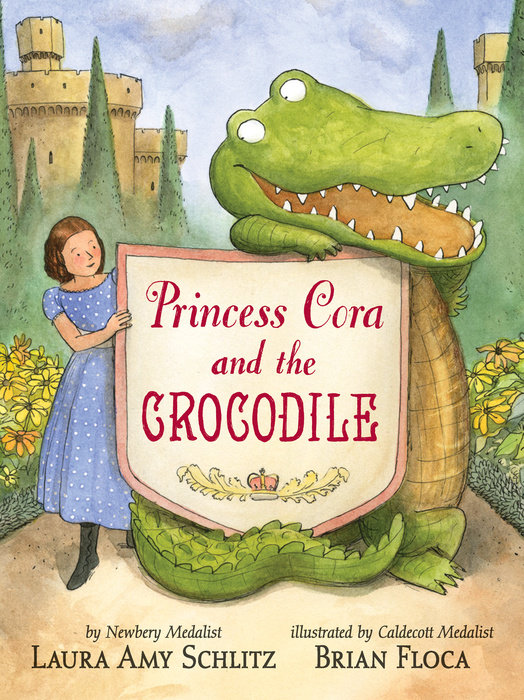
Princess Cora and the Crocodile by Laura Amy Schlitz, illustrated by Brian Floca
Cora’s parents love her dearly. So dearly, they worry about all the things that could go wrong. They want to make sure she is prepared, so they schedule her so that every minute of every day is spent in training. She takes three baths a day, she spends hours poring over boring books, and her father makes sure she gets a rigorous workout every single day. Cora is sick of it! She wants to be able to get dirty and play and have a dog. She writes her fairy godmother in desperation:
Nobody listens to me. My mother and father won’t let me have a pet and Nanny says I don’t even want one. But I do. And I’m sick and tired of everything.
Please help me.
Love,
Princess Cora
The next morning, a box with breathing holes in it is sitting at the foot of her bed. But it’s not the furry, golden dog she’d wished for, it’s a crocodile! What follows is a hilarious misadventure as Cora finally gets to play, and the crocodile takes her place during lessons.
You know it’s going to be great when one of the first things out of the crocodile’s mouth is “I bite.” The crocodile often resembles a two-year-old as much as a crocodile and gets into all sorts of trouble in his ridiculous Cora costume. Silliness and laughs abound.
Even though the crocodile gets most of the laughs, the story is about Cora and her parents. In an interview, Laura Amy Schlitz said, “It surprises me that there are so few picture books about the conflicts between parents and children. That’s odd, when you think about it, because this is where children live: with their parents, in a love-haunted combat zone. I’m not talking about abusive parents, or delinquent children; I’m talking about parents who are trying desperately to be good parents, and children who are trying hopelessly to be good children.” I was also struck by the fact that Cora retains her respectfulness. She never devolves into a brat, she doesn’t hate her parents, she doesn’t throw all of her responsibilities out the window. That’s for the crocodile. What Cora needs is some adventure, some play, and some independence.
Laura Amy Schlitz is one of my favorite children’s authors out there. Her books always seem to have a classic, timeless feel to them. They entertain and charm. Princess Cora and the Crocodile is no exception. She balances sweetness with humor and mischief. Brian Floca’s illustrations are a perfect match. If ever there was a perfect easy chapter book, this is it.
Sunday, December 24, 2017
Friday, December 22, 2017
Recent Read: The Gentleman's Guide to Vice & Virtue
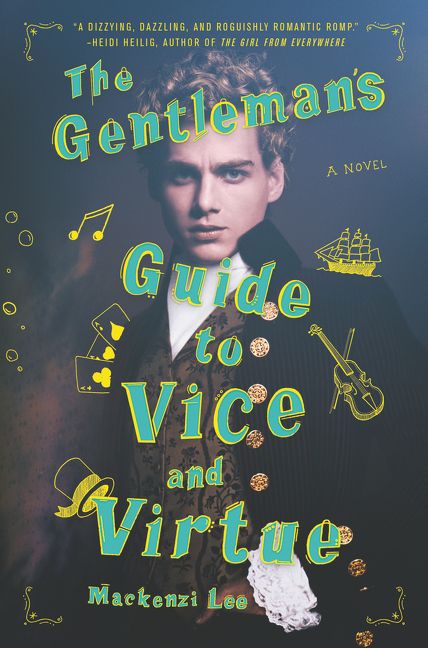
The Gentleman's Guide to Vice and Virtue by MacKenzi Lee
“On the morning we are to leave for our Grand Tour of the Continent, I wake in bed beside Percy. For a disorienting moment it’s unclear whether we’ve slept together or simply slept together.”
So begins this rollicking romp in 18th Century Europe. Monty is an English gentleman, but he’s also a playboy, regularly getting into compromising positions with both girls and boys. He’s leaving on a grand tour of Europe with his sister, Felicity, and his best friend (and secret crush), Percy. Monty is determined to have one last hurrah before his father imprisons him in gentlemanly adult responsibilities, like marriage and overseeing the estate. He has barely started his adventures in France when, at the Palace of Versailles, he gets caught naked with a courtesan and flees out the window, but not without stealing a pretty box of the Duke of Bourbon’s out of spite. They learn just how valuable this box is when highwaymen run them down the next day. Now, Monty, Percy, and Felicity appear to possess the secret to immortality and must decide what to do with it and manage to stay alive to do it.
This is at once a hilarious, scandalous, and thrilling book that may also surprise you with poignant moments. It was pure enjoyment the whole way through. Lee’s writing was a delight—snarky and funny one moment, tender and poetic the next. Percy and Felicity are lovable without question, while Monty is so selfish and irresponsible, it takes a while (and some growth) before I came to love him as well. It may seem a bit fluffy because of the light tone and humor sprinkled throughout, but Lee includes some pretty serious and ambitious ground: grand tours of Europe (which was a common practice for the upper classes at the time), epilepsy at a time when people had no real understanding of it, ditto for homosexuality, physical abuse, feminism, alcoholism, racism, shall I continue? And yet it all works together. She explains the historical context for many issues covered in the book in her note. Are there anachronisms? Is it a bit rosy to be realistic? Probably. Did I care? Not so much. This book made me laugh, blush, gasp, and fall in love. I warn you, it’s a bit mature for a teen book; there’s a fair amount of raunch, but alas, I absolutely loved it.
“On the morning we are to leave for our Grand Tour of the Continent, I wake in bed beside Percy. For a disorienting moment it’s unclear whether we’ve slept together or simply slept together.”
So begins this rollicking romp in 18th Century Europe. Monty is an English gentleman, but he’s also a playboy, regularly getting into compromising positions with both girls and boys. He’s leaving on a grand tour of Europe with his sister, Felicity, and his best friend (and secret crush), Percy. Monty is determined to have one last hurrah before his father imprisons him in gentlemanly adult responsibilities, like marriage and overseeing the estate. He has barely started his adventures in France when, at the Palace of Versailles, he gets caught naked with a courtesan and flees out the window, but not without stealing a pretty box of the Duke of Bourbon’s out of spite. They learn just how valuable this box is when highwaymen run them down the next day. Now, Monty, Percy, and Felicity appear to possess the secret to immortality and must decide what to do with it and manage to stay alive to do it.
This is at once a hilarious, scandalous, and thrilling book that may also surprise you with poignant moments. It was pure enjoyment the whole way through. Lee’s writing was a delight—snarky and funny one moment, tender and poetic the next. Percy and Felicity are lovable without question, while Monty is so selfish and irresponsible, it takes a while (and some growth) before I came to love him as well. It may seem a bit fluffy because of the light tone and humor sprinkled throughout, but Lee includes some pretty serious and ambitious ground: grand tours of Europe (which was a common practice for the upper classes at the time), epilepsy at a time when people had no real understanding of it, ditto for homosexuality, physical abuse, feminism, alcoholism, racism, shall I continue? And yet it all works together. She explains the historical context for many issues covered in the book in her note. Are there anachronisms? Is it a bit rosy to be realistic? Probably. Did I care? Not so much. This book made me laugh, blush, gasp, and fall in love. I warn you, it’s a bit mature for a teen book; there’s a fair amount of raunch, but alas, I absolutely loved it.
Thursday, December 21, 2017
Recent Read: Scythe
Scythe by Neal Shusterman
Imagine a world with no hunger, no disease, no misery, no death. Because no death exists naturally, Scythes are designated to “glean” (permanently kill) people, ostensibly to prevent overpopulation.
This is the world in which teens, Citra and Rowan, live. Chosen as apprentice scythes by the ascetic Scythe Faraday, they reluctantly begin to learn the art and craft of death. Scythe Faraday instills in them a reverence and respect for human life and the work of scythes. But not all scythes subscribe to the same philosophy. Elsewhere in the Scythedom, a movement is forming to embrace the violence and death of their work, placing themselves as superior to the unappointed citizenry. Citra and Rowan find themselves caught in the middle of this battle, and must figure out how to come out of it all alive. (Kind of vague I know, but sometimes knowing less gives you more enjoyment in the reading.)
Now, the idea that the entire world would agree that the best way to control the population was to designate a small group of people who are above the law to kill people by whatever method they prefer seems a bit ludicrous. Just the idea that gleaning someone by flame-thrower or bowie knife would be acceptable rather than some universally accepted humane method is hard to believe. And those aren’t the only qualms I have. But if you can buy into the world-building, this is a compelling, thought-provoking read.
The existence of such a truly utopian world prompts all sorts of questions about the nature and purpose of life and death. Is pain required to feel joy? What does life become when there may be no end? But it’s not just philosophical, the story is good. There are unpredictable twists around every corner. It’s filled with action and suspense. The characters are each so distinct, and their arcs drive the story as much as the plot. I couldn't put it down, and I loved the way it made me think.
Just as a note, this is a violent book...and yet, not explicitly so. In his straightforward, unadorned style, Shusterman describes horrifying events, but there is no gore. It's not graphic. If you're worried, compare it to The Hunger Games.
Imagine a world with no hunger, no disease, no misery, no death. Because no death exists naturally, Scythes are designated to “glean” (permanently kill) people, ostensibly to prevent overpopulation.
This is the world in which teens, Citra and Rowan, live. Chosen as apprentice scythes by the ascetic Scythe Faraday, they reluctantly begin to learn the art and craft of death. Scythe Faraday instills in them a reverence and respect for human life and the work of scythes. But not all scythes subscribe to the same philosophy. Elsewhere in the Scythedom, a movement is forming to embrace the violence and death of their work, placing themselves as superior to the unappointed citizenry. Citra and Rowan find themselves caught in the middle of this battle, and must figure out how to come out of it all alive. (Kind of vague I know, but sometimes knowing less gives you more enjoyment in the reading.)
Now, the idea that the entire world would agree that the best way to control the population was to designate a small group of people who are above the law to kill people by whatever method they prefer seems a bit ludicrous. Just the idea that gleaning someone by flame-thrower or bowie knife would be acceptable rather than some universally accepted humane method is hard to believe. And those aren’t the only qualms I have. But if you can buy into the world-building, this is a compelling, thought-provoking read.
The existence of such a truly utopian world prompts all sorts of questions about the nature and purpose of life and death. Is pain required to feel joy? What does life become when there may be no end? But it’s not just philosophical, the story is good. There are unpredictable twists around every corner. It’s filled with action and suspense. The characters are each so distinct, and their arcs drive the story as much as the plot. I couldn't put it down, and I loved the way it made me think.
Just as a note, this is a violent book...and yet, not explicitly so. In his straightforward, unadorned style, Shusterman describes horrifying events, but there is no gore. It's not graphic. If you're worried, compare it to The Hunger Games.
Wednesday, December 20, 2017
Recent Read: The 57 Bus
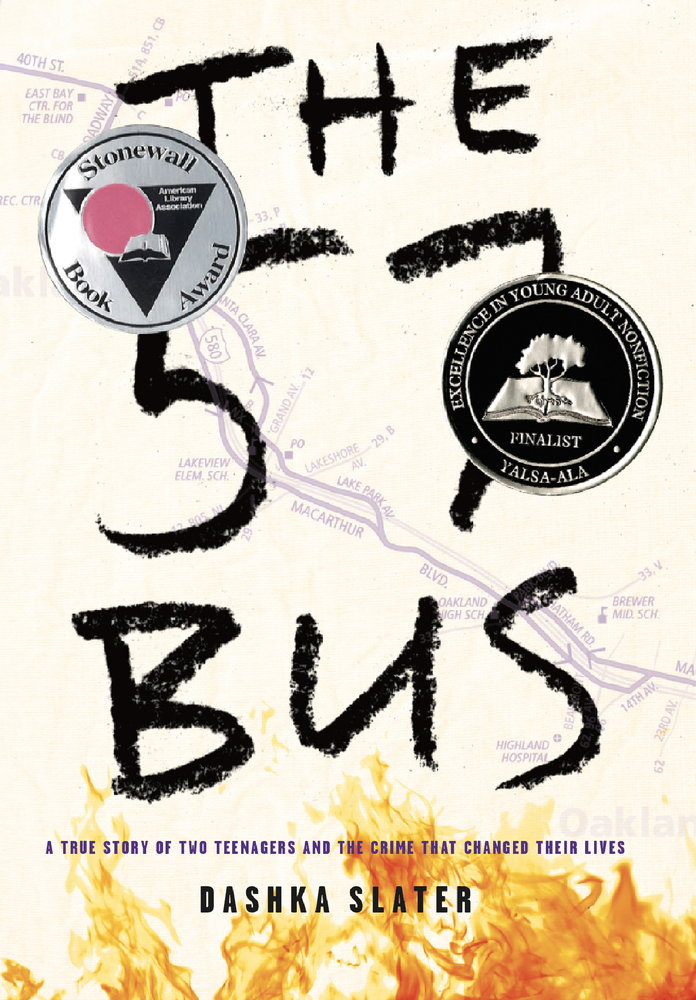
The 57 Bus by Dashka Slater
In November 2013, an agender teen riding the 57 bus was set on fire. The story became international news. The victim suffered horrible third degree burns. Many asked why. The answer the press and the district attorney’s office provided was simple: bigotry. To many it was a simple black and white case of right vs wrong.
Dashka Slater, the journalist who first covered the story for New York Times Magazine, tells a bit of a different story. She tells the story of two kids whose lives were both drastically changed in an instant. Sasha was a gender nonconforming teen with Asperger’s from a middle class white home who asked to be called by the pronouns they/them/theirs. Richard was a good natured teen from the inner city who was trying to improve his life despite the difficulties he faced. They both had friends and loving families. Slater describes two well-loved teens, good kids. So how did everything go so wrong? What kind of crime was committed and what is the punishment that fits it?
Slater goes into depth, describing where the teens came from their environments and the justice system that will determine Richard’s fate. It’s rife with hot button issues—race, class, transgenderism, incarceration, bullying, to name a few—but Slater handles them with sensitivity. She is even-handed in her portrayal of the teens, and you might be surprised by how much sympathy you feel for both. Dreadful as the whole thing may sound, the human spirit miraculously shines through. There is inspiration and heart to be found even here.
In November 2013, an agender teen riding the 57 bus was set on fire. The story became international news. The victim suffered horrible third degree burns. Many asked why. The answer the press and the district attorney’s office provided was simple: bigotry. To many it was a simple black and white case of right vs wrong.
Dashka Slater, the journalist who first covered the story for New York Times Magazine, tells a bit of a different story. She tells the story of two kids whose lives were both drastically changed in an instant. Sasha was a gender nonconforming teen with Asperger’s from a middle class white home who asked to be called by the pronouns they/them/theirs. Richard was a good natured teen from the inner city who was trying to improve his life despite the difficulties he faced. They both had friends and loving families. Slater describes two well-loved teens, good kids. So how did everything go so wrong? What kind of crime was committed and what is the punishment that fits it?
Slater goes into depth, describing where the teens came from their environments and the justice system that will determine Richard’s fate. It’s rife with hot button issues—race, class, transgenderism, incarceration, bullying, to name a few—but Slater handles them with sensitivity. She is even-handed in her portrayal of the teens, and you might be surprised by how much sympathy you feel for both. Dreadful as the whole thing may sound, the human spirit miraculously shines through. There is inspiration and heart to be found even here.
Tuesday, December 19, 2017
Recent Read: I'm Just No Good at Rhyming
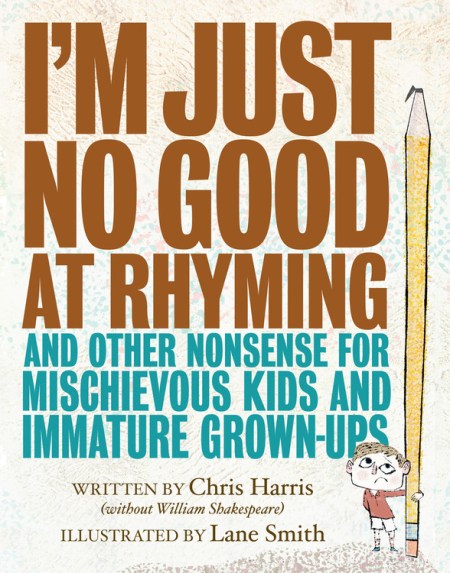
I'm Just No Good at Rhyming and Other Nonsense for Mischievous Kids and Immature Grown-Ups by Chris Harris, illustrated by Lane Smith
I'm just no good at rhyming.
It makes me feel so bad.
I'm just no good at rhyming,
And that's why I am blue.
But in reality, Chris Harris IS good at rhyming in this hilarious collection of clever poetry. Everything about this book is funny, including the dedications, acknowledgments, & author bios. It includes word play, mischief, riddles, reader interaction, stories, and tons of silliness. In “The Good-Child Test,” Harris writes, “I used special ink on this poem’s last line / That some children see and some don’t / If you’re a good child, then you’ll read it just fine — ” And of course the space is left blank (or maybe I'm just a bad child who can't see it??). There’s the “Alphabet Book (by the laziest artist in the world)” where every letter looks the same: “K is for kiwi (halved),” “O is for orchestra pit,” “Q is for quail (under a serving lid)”. “If you ever have to memorize a poem of twenty lines or longer and deliver it to your class, then this is a pretty good choice” is a poem with only two words in it, moderated by intonation. I loved the “Unfair Riddles,” which are exactly what they say they are. Every now and then there is interference from the illustrator (“Sorry, Chris, I have to stop you right there. This poem is too ridiculous. I don’t think I can illustrate it.”). Even his indices are funny. An “Outdex” includes a list of poems not in the book like, “Syrup in Europe Makes Me Therup.” There are even a few sweet poems without a punchline. Lane Smith of Stinky Cheese Man fame has created illustrations that perfectly complement and accentuate the humor. The title says it all, and certainly I must fit the latter category because I laughed my way through the whole thing.
I'm just no good at rhyming.
It makes me feel so bad.
I'm just no good at rhyming,
And that's why I am blue.
But in reality, Chris Harris IS good at rhyming in this hilarious collection of clever poetry. Everything about this book is funny, including the dedications, acknowledgments, & author bios. It includes word play, mischief, riddles, reader interaction, stories, and tons of silliness. In “The Good-Child Test,” Harris writes, “I used special ink on this poem’s last line / That some children see and some don’t / If you’re a good child, then you’ll read it just fine — ” And of course the space is left blank (or maybe I'm just a bad child who can't see it??). There’s the “Alphabet Book (by the laziest artist in the world)” where every letter looks the same: “K is for kiwi (halved),” “O is for orchestra pit,” “Q is for quail (under a serving lid)”. “If you ever have to memorize a poem of twenty lines or longer and deliver it to your class, then this is a pretty good choice” is a poem with only two words in it, moderated by intonation. I loved the “Unfair Riddles,” which are exactly what they say they are. Every now and then there is interference from the illustrator (“Sorry, Chris, I have to stop you right there. This poem is too ridiculous. I don’t think I can illustrate it.”). Even his indices are funny. An “Outdex” includes a list of poems not in the book like, “Syrup in Europe Makes Me Therup.” There are even a few sweet poems without a punchline. Lane Smith of Stinky Cheese Man fame has created illustrations that perfectly complement and accentuate the humor. The title says it all, and certainly I must fit the latter category because I laughed my way through the whole thing.
Monday, December 18, 2017
Recent Read: Real Friends
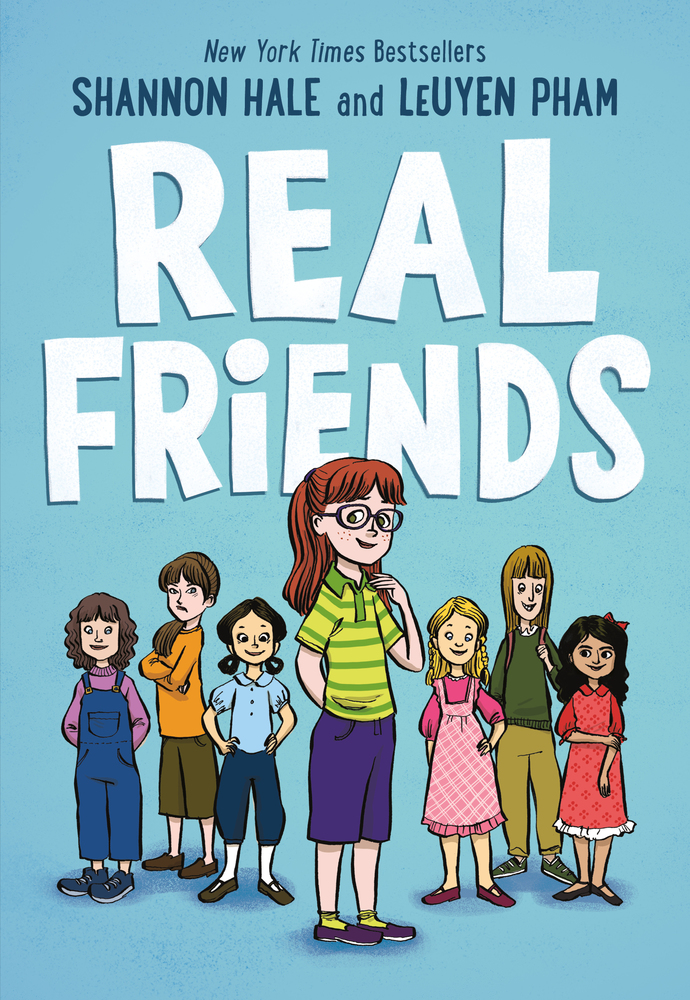
Real Friends by Shannon Hale, illustrated by LeUyen Pham
Friendship is not always an easy thing to navigate. Shannon Hale recalls her own real childhood in this memoir about the hazards of making friends. She becomes instant best friends with Adrienne in kindergarten, but it becomes a little more complicated in third grade when Adrienne becomes friends with the most popular girl in her class. Adrienne is welcomed at the top of the pack while Shannon is relegated to the bottom. Often others (particularly one) in “The Group” make fun of Shannon and try to undermine her. Meanwhile, at home, her oldest sister, Wendy, is alternately nice and abusive. Hale and Pham depict Wendy as a wild bear who could strike at any moment. Shannon has days where she spends recess crying in the bushes and gets home only to have to run from the bear. Her path is not always clear, but through all the messiness of real life, Shannon learns what it is to have and be a real friend.
I think sometimes we think of these social hierarchy problems (queen bees and wannabes) emerging in middle or high school, but I experienced them most strongly in elementary school, and it looks like Shannon Hale might have as well. I remember being phased out of the cool group when I was in third grade. As I saw Shannon’s pain, I felt it and related to it. LeUyen Pham notes in the acknowledgments, “my heart is still convinced that you [Hale] crawled inside my memories and handpicked all these events and feelings and insecurities from my childhood and called them your own.” I tend to think that the book will have this effect on many readers, as it did me. And while I had no siblings, the portrayal of her difficulties with her sister still affected me because of the authenticity of it. Hale deftly maneuvers through this story, and while the central focus is friendship (particularly female), she manages to touch on other complex subjects like anxiety, sister relationships, empathy, and identity.
In the lovely author’s note, Hale says, “Real Friends is the story I’ve been telling myself about my elementary school years. If you were to ask the other people portrayed in this book how it happened, surely the story they’ve been telling themselves would be different from mine.” She provides a little extra context and some follow up on some of the people in the story, like Wendy. She wraps it up by encouraging her readers, “You deserve to have real friends.”
Then there are the illustrations! It’s so easy to take illustrations for granted. LeUyen Pham's illustrations brim with life. She captures all the emotions so brilliantly in her drawings. She knows how to use color and space to accentuate and depict the story. She incorporates the bear and dreamy fantasy sequences seamlessly. I can’t do her work justice!
And did I mention it was so engaging I read it in one sitting? Regardless of whatever personal, emotional impact this may have had on me, this is one fantastic little book.
Friendship is not always an easy thing to navigate. Shannon Hale recalls her own real childhood in this memoir about the hazards of making friends. She becomes instant best friends with Adrienne in kindergarten, but it becomes a little more complicated in third grade when Adrienne becomes friends with the most popular girl in her class. Adrienne is welcomed at the top of the pack while Shannon is relegated to the bottom. Often others (particularly one) in “The Group” make fun of Shannon and try to undermine her. Meanwhile, at home, her oldest sister, Wendy, is alternately nice and abusive. Hale and Pham depict Wendy as a wild bear who could strike at any moment. Shannon has days where she spends recess crying in the bushes and gets home only to have to run from the bear. Her path is not always clear, but through all the messiness of real life, Shannon learns what it is to have and be a real friend.
I think sometimes we think of these social hierarchy problems (queen bees and wannabes) emerging in middle or high school, but I experienced them most strongly in elementary school, and it looks like Shannon Hale might have as well. I remember being phased out of the cool group when I was in third grade. As I saw Shannon’s pain, I felt it and related to it. LeUyen Pham notes in the acknowledgments, “my heart is still convinced that you [Hale] crawled inside my memories and handpicked all these events and feelings and insecurities from my childhood and called them your own.” I tend to think that the book will have this effect on many readers, as it did me. And while I had no siblings, the portrayal of her difficulties with her sister still affected me because of the authenticity of it. Hale deftly maneuvers through this story, and while the central focus is friendship (particularly female), she manages to touch on other complex subjects like anxiety, sister relationships, empathy, and identity.
In the lovely author’s note, Hale says, “Real Friends is the story I’ve been telling myself about my elementary school years. If you were to ask the other people portrayed in this book how it happened, surely the story they’ve been telling themselves would be different from mine.” She provides a little extra context and some follow up on some of the people in the story, like Wendy. She wraps it up by encouraging her readers, “You deserve to have real friends.”
Then there are the illustrations! It’s so easy to take illustrations for granted. LeUyen Pham's illustrations brim with life. She captures all the emotions so brilliantly in her drawings. She knows how to use color and space to accentuate and depict the story. She incorporates the bear and dreamy fantasy sequences seamlessly. I can’t do her work justice!
And did I mention it was so engaging I read it in one sitting? Regardless of whatever personal, emotional impact this may have had on me, this is one fantastic little book.
Saturday, December 16, 2017
Recent Read: City of Saints and Thieves
City of Saints and Thieves by Natalie C. Anderson
“If you’re going to be a thief, the first thing you need to know is that you don’t exist.”
Tina is an excellent thief. She knows how not to exist—how to go through a crowd unnoticed, swiping valuables from unsuspecting victims. She and her mother practiced the same kind of invisibility as they slipped away from Congo as refugees, landing in Kenya where her mother found a job working as a maid for the prominent and wealthy American businessman, Roland Greyhill. It was there, in Greyhill’s office, that Tina’s mother was murdered years ago.
Now Tina returns to the scene of the crime, hoping to exact revenge on the man who murdered her mother. With the help of her street gang, she plans to hack Greyhill’s computer and acquire secrets to ruin and bankrupt him. Everything is going according to plan until she's interrupted by his teenage son, Michael, her former best friend.
Michael doesn’t believe his father did it and convinces Tina to hold off on her revenge until he can acquire the security footage of what really happened that night. What follows is a compelling murder mystery. Twists lurk around every corner as Tina and Michael delve deeper into her mother’s history—including why and how her mother fled Congo.
I listened to Pascale Armand read this as an audiobook. Her narration combined with the developed characters, vivid setting, and good writing made for a very enjoyable read. But while the driving force of the book is this exciting murder mystery, at its heart lies a story of victims of conflict in Africa. The author worked for NGOs in Africa, and for 3 years, she interviewed refugees seeking asylum in the U.S. Her job was to listen to refugees tell their stories all day. In an interview, she said, “What I’d heard was every bit as compelling and engrossing as any dystopian or post-apocalyptic world.” It’s true, we have real life dystopias in our world today. Anderson handles this most heart wrenching part of the story with grace, delicacy, and, dare I say, even beauty. So while it is an excellent murder mystery, it’s also much more.
“If you’re going to be a thief, the first thing you need to know is that you don’t exist.”
Tina is an excellent thief. She knows how not to exist—how to go through a crowd unnoticed, swiping valuables from unsuspecting victims. She and her mother practiced the same kind of invisibility as they slipped away from Congo as refugees, landing in Kenya where her mother found a job working as a maid for the prominent and wealthy American businessman, Roland Greyhill. It was there, in Greyhill’s office, that Tina’s mother was murdered years ago.
Now Tina returns to the scene of the crime, hoping to exact revenge on the man who murdered her mother. With the help of her street gang, she plans to hack Greyhill’s computer and acquire secrets to ruin and bankrupt him. Everything is going according to plan until she's interrupted by his teenage son, Michael, her former best friend.
Michael doesn’t believe his father did it and convinces Tina to hold off on her revenge until he can acquire the security footage of what really happened that night. What follows is a compelling murder mystery. Twists lurk around every corner as Tina and Michael delve deeper into her mother’s history—including why and how her mother fled Congo.
I listened to Pascale Armand read this as an audiobook. Her narration combined with the developed characters, vivid setting, and good writing made for a very enjoyable read. But while the driving force of the book is this exciting murder mystery, at its heart lies a story of victims of conflict in Africa. The author worked for NGOs in Africa, and for 3 years, she interviewed refugees seeking asylum in the U.S. Her job was to listen to refugees tell their stories all day. In an interview, she said, “What I’d heard was every bit as compelling and engrossing as any dystopian or post-apocalyptic world.” It’s true, we have real life dystopias in our world today. Anderson handles this most heart wrenching part of the story with grace, delicacy, and, dare I say, even beauty. So while it is an excellent murder mystery, it’s also much more.
Tuesday, December 12, 2017
Recent Read: Shadow Magic
Shadow Magic by Joshua Khan
A lowly woodcutter's son, Thorn has been enslaved for breaking the law. He thinks he's got it pretty bad until a mysterious man in black purchases him, a man who he discovers is the executioner of House Shadow. Now on his way to Gehenna, the land of darkness, he's pretty sure he'll be stuck cutting up corpses for the oven. He imagines that Lilith, the new ruler is a troll with warts and green skin, but nothing could be further from the truth.
Lilly was never supposed to rule Gehenna. She's a young girl who must take the throne after her family is mysteriously murdered. She comes from a long line of powerful sorcerers, but not only do the powerful glory days of magic seem to be a thing of the past, women are not allowed to practice sorcery. Even though she desperately wants to practice magic and rule on her own, she is being pressured to marry into power and protection.
As you might suspect, Lilly and Thorn are thrown together in an exciting and often humorous adventure that involves murder, necromancy, magic and an enormous bat named Hades. I felt the same kind of enjoyment reading this story as I did reading Harry Potter. It's a page turner with humor, appealing characters, and lots of charm.
A lowly woodcutter's son, Thorn has been enslaved for breaking the law. He thinks he's got it pretty bad until a mysterious man in black purchases him, a man who he discovers is the executioner of House Shadow. Now on his way to Gehenna, the land of darkness, he's pretty sure he'll be stuck cutting up corpses for the oven. He imagines that Lilith, the new ruler is a troll with warts and green skin, but nothing could be further from the truth.
Lilly was never supposed to rule Gehenna. She's a young girl who must take the throne after her family is mysteriously murdered. She comes from a long line of powerful sorcerers, but not only do the powerful glory days of magic seem to be a thing of the past, women are not allowed to practice sorcery. Even though she desperately wants to practice magic and rule on her own, she is being pressured to marry into power and protection.
As you might suspect, Lilly and Thorn are thrown together in an exciting and often humorous adventure that involves murder, necromancy, magic and an enormous bat named Hades. I felt the same kind of enjoyment reading this story as I did reading Harry Potter. It's a page turner with humor, appealing characters, and lots of charm.
Subscribe to:
Posts (Atom)