Pages

Showing posts with label children's. Show all posts

Monday, August 16, 2021

Best Picture Books of 2020

I finally caught up with 2020 books. Here is my rather indecisive list of the best of 2020.


1. In the Half Room by Carson Ellis

A half house next to a half tree, filled with half objects, a half cat and even a half person. Reminiscent of Goodnight Moon except whimsical, absurd, and surreal. The more times I read it, the more I loved it! 


1. Sugar in Milk by Thrity Umrigar, illustrated by Khoa Le

A young immigrant girl feels homesick, and her aunt tells her a story. A group of refugees landed in a kingdom where they don't speak the language. The king and the refugees speak through symbols. The king shows them a full glass of milk with "no room for more." The refugees show the king a spoonful of sugar which they drop into the milk. The sugar both dissolves and sweetens without it overflowing. The king allows them in, and they promise to add sweetness to life wherever they are. The girl, upon hearing this story, reenters the world with new eyes. "Nothing had changed. And yet, everything had." She goes about her life offering smiles and kindness--sugar--to all around her. She sweetens both her own life and the lives others, and in the process finds a warm home. 

Could there be a better book for the year we all just went through? I love how the story is not just one story with one thesis/moral/message. There are many stories and many inspirations to be found in its pages. The illustrations are intricate and beautiful. Elaborate patterns are incorporated into clothing and backgrounds and borders. The legend is framed, reminiscent of old parchment, making it easy to distinguish from the modern story. The illustrator communicates well the feelings in the book--the bleakness of solitude, followed by the literal flowering of kindness. 


1. Bunnies on the Bus by Philip Ardagh, illustrated by Ben Mantle

"Bunnies on the Bus! Bunnies on the bus! No wonder there's a fuss about bunnies on the bus!" Every page of this book is jam-packed with bunny havoc. Newspapers, cakes, mail, packages all go flying as they whizz past. The trouble-making bunnies themselves are a bit nuts, hanging out of windows, stuffing carrots into their mouths, chasing after balloons, and the list goes on. And then there are all the stories happening in the background--the front-page escaped convicts conducting another heist, a bear getting ready for a date with his sweetheart, the celebrity hair model lion whose haircut goes terribly wrong (thanks to the bunnies, of course), and this list goes on, too. It rhymes and there's repetition. It's tons of fun all around. 


4. My Best Friend by Julie Fogliano, illustrated by Jillian Tamaki

The joys of childhood and friendship captured in one book. It only takes moments for two girls who meet in the park to be best friends. Silliness and imagination abound as the girls quack like ducks, pretend to be a pickle, and turn a leaf into a skeleton hand. But it's not just fun and games. They care for one another, try to make things better for each other, and are still best friends, even when they disagree on ice cream flavors. You can see pure, unadulterated joy shining out of the girls faces as they laugh and play. It's hard not to share in it. 


5. The Oldest Student: How Mary Walker Learned to Read by Rita L. Hubbard, illustrated by Oge Mora

 Mary Walker was born into slavery, forbidden to read. At the age of 15, slavery ended in the US, and while technically she was free to learn, the hardships of life prevented her from pursuing her desire. It wasn't until she was 116, after her entire family had died, that she stepped into a reading class and became the oldest student. It's an amazing story, and this picture book tells it beautifully. It's no secret that I'm a huge fan of Oge Mora, and her illustrations shine as they always do here. Rita Lorraine Hubbard's text is excellent also. It was when I read it aloud that I really noticed the beauty of the text: instances of alliteration, the flow of language, the imagery, the little details that make you stop and think. And there was a lovely circularity to the story. Mary sees birds and dreams of freedom and reading as a child at the beginning, and at the end she has learned to read and flies through the air on an airplane, like one of those birds. Beautiful! 


6. Rita and Ralph's Rotten Day by Carmen Agra Deedy, illustrated by Pete Oswald

Rita and Ralph are best friends, but when their play gets a little out of hand and one of them gets hurt, they part ways. Ralph feels bad and Rita is mad. The thing is, in order to get to Rita's house to apologize, there are a number of hills Ralph must climb up and down (4 to be precise), and by the time he goes all that way he's tired and grumpy and doesn't sound particularly sorry. They go back and forth (down the hill and up the hill and down the hill and up the hill and down the hill...) a number of times before finally meeting in the middle in their usual place, both apologizing. Humor is found in the repetitive trips over all those hills, but also in their individual grumpiness. It's a great story about what goes into maintaining friendships when harm, sometimes unintentional and sometimes not, is done. The author's note says, "Nothing feels worse than hurting a friend. Breaking things takes little effort; mending them takes time, humility, and a heap of trips up and down the hills of reconciliation." 


7. Polar Bear in the Snow by Mac Barnett, illustrated by Shawn Harris

The title says it all. This is a book about a polar bear in the snow. The almost all white paper cut illustrations are all about texture, lighting, and the occasional black accents that define faces. The effects he's able to create are stunning. 


8.
Lift by Minh Lê, illustrated by Dan Santat

Iris loves to press elevator buttons. She always presses them--that is until her little brother swoops in and starts pushing them instead. Frustrated, she grabs an old elevator button she sees in the trash and so she can press the button in the privacy of her own bedroom, even if it doesn't do anything. Except that when she presses the button, something does happen. Her bedroom door opens to reveal another world. Humor, imagination, and sibling relationships are all in display in this lushly illustrated picture book. 

9. The Fabled Life of Aesop by Ian Lendler, illustrated by Pamela Zagarenski

Aesop's life was fabled in many ways. Fabled because his name became so well known, fabled because of the fables he told, and fabled because his life itself was a fable. Born a slave, Aesop learned to communicate with his masters through fables. His wisdom was so great that he helped his master become successful both in business and in character. When his master asked if he could reward him, Aesop told another fable, indicating his desire for freedom, which he was granted. It's an incredible story. We don't know if it's really true, but it's inspiring nonetheless. Lendler tells this story well, incorporating Aesop's fables in real-life situations where they might have been used as well as including a collection of fables, some of which are very familiar and others less so. The illustrations are lovely—especially those on glossy pages for the fables themselves. An afterword shares a little historical context and detail.


10. Friday Night Wrestlefest by J. F. Fox, illustrated by Micah Player

"Ladies and gentleman, it's Friday night! That's right. School is out. Dinner was pizza. Annnnd best of all...it's time for...FRIDAY NIGHT WRESTLEFEST Main Event: Battle the Bedtime" Funny, dynamic, saturated with color, this is a ton of fun. And yes, it is a bedtime book. 


10. Prairie Days by Patricia MacLachlan, illustrated by Micah Archer

Big sky and endless prairies are the hallmarks of a childhood in Wyoming, lovingly remembered in Prairie Days. The collage illustrations are vibrant and stunning. 


Honorable Mention:


Bedtime for Sweet Creatures by Nikki Grimes, illustrated by Elizabeth Zunon

If You Come to Earth by Sophie Blackall

On Account of the Gum by Adam Rex

Drawing on Walls: A Story of Keith Haring by Matthew Burgess, illustrated by Josh Cochran


Wednesday, January 31, 2018

Best Picture Books of 2017


1. A Perfect Day by Lane Smith
A Perfect Day starts so nicely, so peacefully, and then bear enters the picture, and each “was” turns into a “WAS.” Turns out, sometimes what you consider perfect is all about perspective. Hilarious and simple. The multimedia illustrations are rich in texture, and Smith uses scale to the greatest advantage to tell the story and create laughs. Don’t miss the note about the real bear who visits Lane Smith’s studio!


2. The Wolf the Duck & the Mouse by Mac Barnett, illustrated by Jon Klassen
Mac Barnett and Jon Klassen strike again! In this misadventure, a mouse is gobbled up by a wolf, but instead of meeting its end, the mouse finds a duck. Apparently, being swallowed isn’t the worst thing when you make a home inside the wolf’s belly. Plus, you don’t have to worry about being eaten by wolves! The two friends' partying leads to a bit of trouble, but their hilarious solution saves the day. Klassen and Barnett are true masters of comedy and storytelling. Klassen's textured mixed media illustrations are a delight as usual. How does he get so much expression out of a pair of ovals and circles?


3. Now by Antoinette Portis
Now could not be more appropriately titled. All about appreciating the moment and wondering at the world, this is a bit of mindfulness for the younger set. Antoinette Portis explores the senses and experiences of childhood that are familiar to young readers with bold, colorful illustrations and a bit of humor.


4. Priscilla Gorilla by Barbara Bottner, illustrated by Michael Emberly
For Priscilla, it’s all gorillas all the time. And why does she like them so much? “They always get their way,” she explains. She dresses as a gorilla for a report at school. Inspired by her favorite quality, she decides she will stay a gorilla for the rest of the day, even when her teacher tells her it’s time to change out of her costume. Her behavior causes a chain reaction that means a lot of time in the “thinking corner” for a lot of kids. When her parents prompt her to dig a little deeper, Priscilla may learn there’s more to gorillas than just getting their way. This is an exuberant story that blends childhood passions (that border on obsession) with a lesson on cooperation and behavior that never veers into didacticism. Michael Emberley’s equally exuberant pencil and watercolor illustrations bring the story to life with personality and humor.


5. Big Cat, Little Cat by Elisha Cooper
At first glance, there's not a lot to this book, but upon closer inspection, I can see life as a whole represented through these two cats: the bigger mentoring the smaller, the two playing, becoming friends, and eventually the bigger succumbing to old age. Cooper illustrates the book in simple but lively black and white ink drawings, which fit the text perfectly.


6. Life on Mars by Jon Agee
“Everybody thinks I’m crazy. Nobody believes there is life on Mars. But I do. And I just know that I’m going to find it.” This young astronaut even brings a cupcake for the life he’s sure he will find. To his great disappointment, he walks around to see no signs of life. But the reader does. Somehow he misses the enormous Martian following him. Just imagine a young reader’s cries of, “Look behind you!” It’s all about dramatic irony and expansive Martian vistas in this hilarious book for young readers.


7. Robinson by Peter Sís
At his mother's suggestion, Peter decides to abandon his plan to dress as a pirate, like his friends, for the costume party. Instead he dresses up in a homemade costume of Robinson Crusoe, the hero of his favorite story. He’s bursting with excitement...until all his friends make fun of him. He goes home, climbs into bed with a fever and drifts into a dream where he’s living inside the story he’s loved for so long. The lush, dreamlike illustrations fill the pages with the wonder and beauty of imagination and art.


8. The Giant Jumperee by Julia Donaldson, illustrated by Helen Oxenbury
Rabbit is minding his own business when a mysterious voice shouts “I’m the giant jumperee and I’m scary as can be!” which proves to be true, as rabbit jumps out of his skin. Rabbit fetches cat and cat fetches bear and bear fetches elephant, but all of them are scared off by the rhyming warnings of a voice coming from a burrow in the ground. But Mama Frog has no fear as, hands on hips, she gives him to the count of three to come out. (Spoiler alert: not even the Giant Jumperee would defy Mama Frog.) With a cozy English feel, The Giant Jumperee reads like a classic, with a little repetition, a little rhyming, a little humor, and warm illustrations.


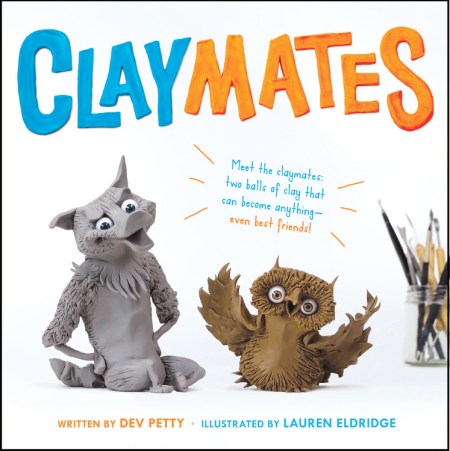
9. Claymates by Dev Petty, illustrated by Lauren Eldridge
What can you do with two blobs of clay? Lauren Eldridge answers that question as she transforms the blobs into two animals: an owl and a wolf. But left to their own devices, the brown and gray clay decide to have a little fun, and turn themselves into all sorts of things. A celebration of play and creativity, with lots of laughs, this stands out as something unique.


10. Noodleheads See the Future by Todd Arnold
Meet mac and mac, the Noodleheads. These elbow macaronis have literally nothing in their heads, and it shows as they misinterpret the world around them and get into trouble. Ziti asks for a hand, and they say they can’t because their hands are attached. Hilarious and silly, it's more than just slapstick.  Arnold has a note in the back of this book, explaining the folk tale origins and inspirations for these stories. He also notes that stories like this help children understand humor and logical thinking. The joy of this easy reader is that the reader understands how figures of speech work and the Noodleheads don't.

Honorable Mention:


Jabari Jumps by Gaia Cornwall
Once Upon a Jungle by Laura Knowles, illustrated by James Boast
A Hundred Billion Trillion Stars by Seth Fishman, illustrated by Isabel Greenberg
The Book of Mistakes by Corinna Luyken
Short Stories for Little Monsters by Marie-Louise Gay


Charlie and Mouse by Laurel Snyder, illustrated by Emily Hughes
Snail and Worm Again by Tina Kugler
Frankie by Mary Sullivan
(This second group of honorable mentions is all easy readers.)

Sunday, December 24, 2017

Recent Read: Princess Cora & the Crocodile

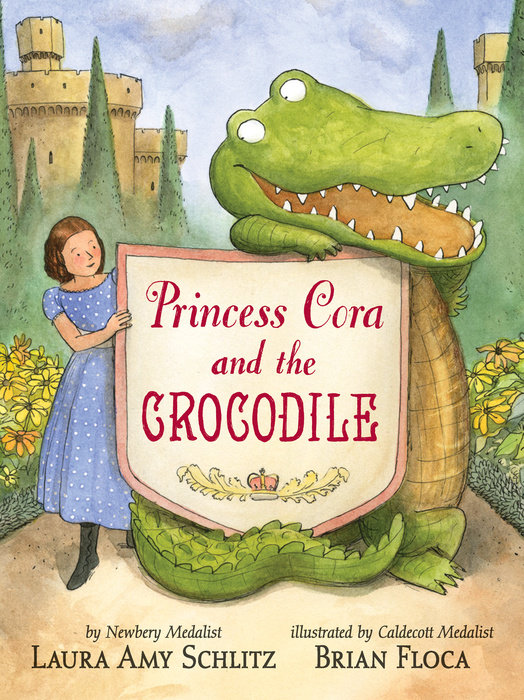
Princess Cora and the Crocodile by Laura Amy Schlitz, illustrated by Brian Floca

Cora’s parents love her dearly. So dearly, they worry about all the things that could go wrong. They want to make sure she is prepared, so they schedule her so that every minute of every day is spent in training. She takes three baths a day, she spends hours poring over boring books, and her father makes sure she gets a rigorous workout every single day. Cora is sick of it! She wants to be able to get dirty and play and have a dog. She writes her fairy godmother in desperation:

Nobody listens to me. My mother and father won’t let me have a pet and Nanny says I don’t even want one. But I do. And I’m sick and tired of everything.
Please help me.
Love,
Princess Cora

The next morning, a box with breathing holes in it is sitting at the foot of her bed. But it’s not the furry, golden dog she’d wished for, it’s a crocodile! What follows is a hilarious misadventure as Cora finally gets to play, and the crocodile takes her place during lessons.

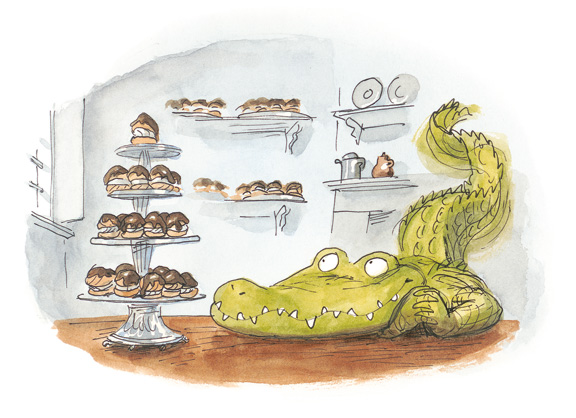
You know it’s going to be great when one of the first things out of the crocodile’s mouth is “I bite.” The crocodile often resembles a two-year-old as much as a crocodile and gets into all sorts of trouble in his ridiculous Cora costume. Silliness and laughs abound.

Even though the crocodile gets most of the laughs, the story is about Cora and her parents. In an interview, Laura Amy Schlitz said, “It surprises me that there are so few picture books about the conflicts between parents and children. That’s odd, when you think about it, because this is where children live: with their parents, in a love-haunted combat zone. I’m not talking about abusive parents, or delinquent children; I’m talking about parents who are trying desperately to be good parents, and children who are trying hopelessly to be good children.” I was also struck by the fact that Cora retains her respectfulness. She never devolves into a brat, she doesn’t hate her parents, she doesn’t throw all of her responsibilities out the window. That’s for the crocodile. What Cora needs is some adventure, some play, and some independence.

Laura Amy Schlitz is one of my favorite children’s authors out there. Her books always seem to have a classic, timeless feel to them. They entertain and charm. Princess Cora and the Crocodile is no exception. She balances sweetness with humor and mischief. Brian Floca’s illustrations are a perfect match. If ever there was a perfect easy chapter book, this is it.


Tuesday, December 19, 2017

Recent Read: I'm Just No Good at Rhyming

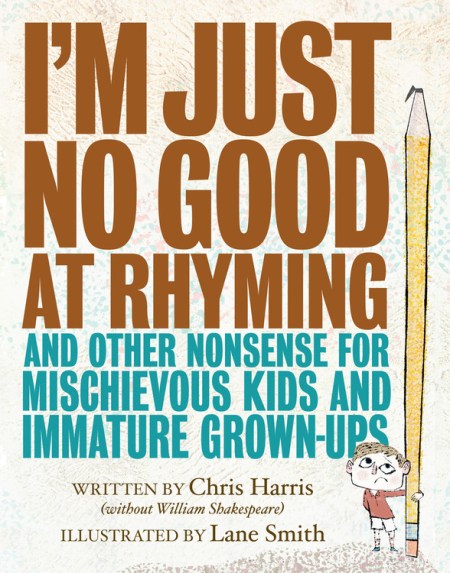
I'm Just No Good at Rhyming and Other Nonsense for Mischievous Kids and Immature Grown-Ups by Chris Harris, illustrated by Lane Smith


I'm just no good at rhyming.
It makes me feel so bad.
I'm just no good at rhyming,
And that's why I am blue.

But in reality, Chris Harris IS good at rhyming in this hilarious collection of clever poetry. Everything about this book is funny, including the dedications, acknowledgments, & author bios. It includes word play, mischief, riddles, reader interaction, stories, and tons of silliness. In “The Good-Child Test,” Harris writes, “I used special ink on this poem’s last line / That some children see and some don’t / If you’re a good child, then you’ll read it just fine — ” And of course the space is left blank (or maybe I'm just a bad child who can't see it??). There’s the “Alphabet Book (by the laziest artist in the world)” where every letter looks the same: “K is for kiwi (halved),” “O is for orchestra pit,” “Q is for quail (under a serving lid)”. “If you ever have to memorize a poem of twenty lines or longer and deliver it to your class, then this is a pretty good choice” is a poem with only two words in it, moderated by intonation. I loved the “Unfair Riddles,” which are exactly what they say they are. Every now and then there is interference from the illustrator (“Sorry, Chris, I have to stop you right there. This poem is too ridiculous. I don’t think I can illustrate it.”). Even his indices are funny. An “Outdex” includes a list of poems not in the book like, “Syrup in Europe Makes Me Therup.” There are even a few sweet poems without a punchline. Lane Smith of Stinky Cheese Man fame has created illustrations that perfectly complement and accentuate the humor. The title says it all, and certainly I must fit the latter category because I laughed my way through the whole thing.


Friday, November 20, 2015

Recent Read: Dream On, Amber

Dream On, Amber by Emma Shevah

 “You know how sometimes you get an idea? And then you follow that idea and complicate your life so badly that you wish it had never popped into your head? Yeah. That’s what happened. Me and my genius idea.”

Eleven-year-old Ambra Alessandra Leola Kimiko Miyamoto, who goes by Amber (“I have no idea why my parents gave me all those hideous names but they must have wanted to ruin my life you know?”), lives with her mom and six-year-old sister, Bella in South London. Her dad left the family when they were little. His absence feels like a gaping hole in Amber’s life. When Bella decides to write a letter to her dad, Amber has an idea. She writes Bella back, posing as their father, hoping to save her sister from the pain that she feels. But of course, this ruse proves difficult to maintain, especially with a sister who has a vivid imagination.

Funny, charming and poignant. This easily could have been sappy or didactic, but Amber’s spunky narration always moderates the more serious subject-matter. Family is central to the book, and while it does highlight the meaning of a dad and having one in your life, it also shows how family is family no matter who is or isn’t there. The way this family comes together and Amber tries to help her sister (even if it is a little ill-advised) is heartening. I loved the characters and enjoyed reading Amber’s narration. The letters exchanged between sisters cracked me up. This is a winner.

Thursday, October 22, 2015

Recent Read: The Nest

The Nest by Kenneth Oppel, illustrated by Jon Klassen

Steven worries a lot. He especially worries about his new brother, who was just born with a host of health problems. Soon after the baby’s birth, an angelic creature visits Steve in his dreams, promising that she can fix the baby. Her vists soothe Steven, and even when he finds out she is the wasp queen building a nest on his roof, he feels good, like everything is going to be all right. But can he really trust the wasp queen? Is she as benevolent as she seems? What does she mean when she refers to the “new” baby? Or is she a figment of his imagination, conjured in a time of anxiety?

The Nest captured me from the very first page. I knew nothing about it. If you would like a similar experience, you may want to stop reading. It’s a hard novel to talk about without giving things away. I’m not including spoilers, but if you want to know less rather than more (I recommend it), now’s the time to go get this excellently crafted horror novel for middle grader readers, and start reading.

The Nest is a trip—an eerie, horrifying trip. This is not the kind of horror that involves gore, murders, or monsters. This seemingly gentle, benevolent wasp queen has offered to help Steven and his family, keep them safe. This is especially appealing to Steve, who has had therapy for his anxiety. And yet something sinister seems to lurk somewhere beneath the surface. The reader is left to infer the wasp queen’s true nature from little details. As Steve warmly thinks about how the wasps are repairing his baby brother, the wasp queen tells him he’ll be even happier when he sees the baby in the crib. “He’s already in the crib,” Steve says, confused. “Not your new baby,” she says in reply. And just like that, Steve’s (and perhaps the reader’s) comfort is replaced by concern and dread. Little by little, Oppel builds on this sense of foreboding until Steve must make crucial decisions about who he trusts and what he values in a nail-biting climax.


Monday, August 3, 2015

Recent Read: Circus Mirandus

Circus Mirandus by Cassie Beasley

“You promised me a miracle…and I have believed through all these years that if I had need of you, you would come. 
…I need you now.”

All his life, Micah Tuttle has heard stories of the wondrous Circus Mirandus, to which his grandfather, Ephraim, gained entry as a child, with a fish caught in his boot acting as a ticket. The circus is a sort of dream world, home to various magical acts and shows, like the Amazing Amazonian Bird Woman, who flies like her exotic birds, and The Man Who Bends Light, a master of illusion who can bring his audiences to shores of an Antarctic iceberg or to the depths of the Amazonian jungle.

But now Grandpa Ephraim’s health is declining, and Micah’s crotchety great aunt Gertrudis is now running the house. When Micah finds out that his grandpa Ephraim has written to request fulfillment of a miracle promised to him by the Lightbender years ago, Micah is sure that the miracle will save his grandfather. With the help of an unexpected new friend, the academically-minded Jenny Mendoza ( “Lightbender…I guess that’s a stage name?” ), Micah sets out to find Circus Mirandis, track down the Lightbender, and save his grandfather with a miracle.

This story was as magical as the circus for which it is named. Micah is trapped in an impossible situation. Aunt Gertrudis is caring for the grandfather he loves, but in the process she suffocates them both, forbidding all talk of magic and often barring Micah from even seeing his grandfather. But just as the desperation of Micah’s situation is palpable, so is the wonder and magic of Circus Mirandus. Micah, in spite of everything, does not doubt or falter. He follows in in the footsteps of Grandpa Ephraim, always pushing ahead, always believing.

Debut author Cassie Beasley alternates chapters about Micah’s and his quest with those about young Ephraim. The characters are well-drawn, the magic world enchanting, and the writing lovely. Also, those illustrations by are a nice addition, contributing to the feel of this novel. It's a celebration of that childlike ability to believe and hope. This is the one to beat. I’m already routing for it to win the Newbery.

Sunday, June 21, 2015

Recent Read: The War That Saved My Life

The War That Saved My Life by Kimberly Brubaker Bradley 

Ada was born with a club foot and it was never repaired. Her abusive mother keeps her locked up in their apartment, calling her a monster because of her ugly foot. When Ada’s little brother Jamie has the opportunity to be evacuated into the country to escape the bombs of an imminent World War II, Ada sneaks away with him.

They are delivered to Oxford-educated Susan and her large, clean, country house. It’s a completely different world for the children—a world with baths, new clothing (including their very first underwear), food, and green grass. And even though it’s an enormous improvement over their home, it’s unfamiliar, and they find themselves overwhelmed and homesick. Ada struggles with the effects of her cruel upbringing. Kindness and acceptance are unfamiliar to her, and sometimes her panic and fear overwhelm her. She finds solace in Susan’s pony, Butter. Susan herself finds it difficult to care for the children, as she is suffering a deep depression after the loss of Becky, the woman she lived with and loved (the true nature of their relationship is for readers to decipher between the lines). The children do not see depression, but a woman who stays in bed all day long, sometimes mutters about not wanting or asking for children, and declares herself to be “not nice.”

Set against the backdrop of an escalating World War II, all three of them start to heal as they care for and come to love one another.

There are so many elements that I found interesting on their own, and they all came together to tell this lovely story. Living in Kent, the war touches their lives in real and oftentimes dramatic ways. The therapeutic comfort of working with horses rang true (I loved hearing things like when Ada feels a “whoosh of breath on [her] neck” ♥) Jamie also has his own challenges to overcome. I loved the authenticity of it all. Each of them finds meaning and purpose as they go beyond their insular worlds to care for one another and get involved in the war effort. Ada’s troubles are not fixed with a simple hug. She suffers long term effects from her mother’s abuse that take time and effort to overcome. And yet, Ada is as instrumental in saving Susan, as Susan is in saving her.

To top it off, this was one of those books that is wonderfully easy to read. I just opened it up and fell into it. And that was that. Before I knew it, it was over. I loved this one!

Saturday, May 9, 2015

Recent Read: Roller Girl

Roller Girl by Victoria Jamieson 

The moment Astrid sees roller derby in action, she’s in love. All she wants to do is become a star player like Rainbow Bite. But her best friend Nicole, with whom she does just about everything, is not as enthused. Astrid finds herself embarking on her new passion alone, while Nicole spends more and more time in ballet with Astrid’s sworn enemy. As Astrid’s fear of losing her best friend takes over, she risks losing Nicole, her new roller derby friend, and her developing roller derby skills.

I loved this book. It’s a story about growing up and figuring out who your friends are and who you are, set against the exciting backdrop of roller derby. When Astrid finds out there’s a roller derby summer camp, she’s in, and she assumes her best friend is with her. Thanks to Jamieson’s deft illustrations, we can see the hesitation in Nicole’s face where Astrid does not. Astrid signs up for camp, and excitedly talks about it with Nicole, only to find that Nicole is not going to derby camp, she’s going to ballet camp.


Now she has to face derby camp all alone, while her best friend spends more and more time with perennial mean girl Rachel. From there, Astrid struggles with the physical difficulty of her would-be passion. Her worry over losing her best friend turns to a sort of vengeful jealousy. She also explores this new-found world of roller derby, with its colorful characters (and hair). I can’t believe how much emotional depth, not to mention entertainment, Jamieson packed into this 240-page book. I fully expect it to make my top 10 at the end of the year.

Wednesday, April 15, 2015

Picture This: Tricky Vic

Tricky Vic: The Impossibly True Story of the Man Who Sold the Eiffel Tower by Greg Pizzoli 

“In 1890, the man who would one day be known by forty-five different aliases was born to the Miller family, in what is now the Czech Republic. His parents named him Robert.”

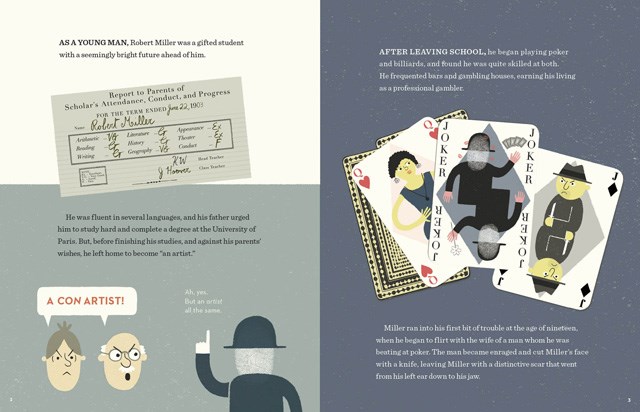
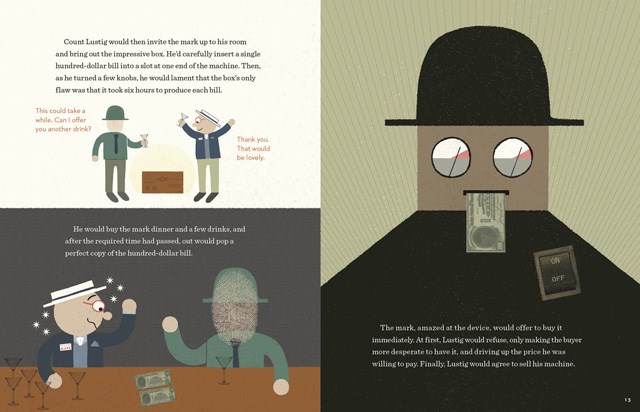
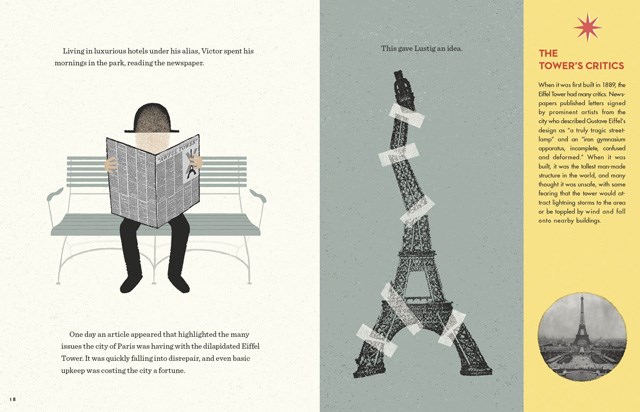
So begins the tale of ultimate con man Tricky Vic (often known as Count Victor Lustig). He was a good student, but before finishing his studies at the University of Paris, he left to pursue a life of deception. His exploits include posing as a count in order to cozy up to rich ocean liner passengers and rob them at the dock, conning Al Capone into thinking he was an honest man, convincing men to buy his money making machine, and, of course, selling a contract for the rights to the Eiffel Tower and its scrap metal. This is a fascinating tale about a liar for the ages.

I think one of the many things that sets this book apart is that it’s a biography for children about a bad guy. No didacticism or heroism to be found, just one unbelievable tale after another, always interesting. Pizzoli’s design-heavy, graphic mixed media illustrations complement the story. He cleverly represents Tricky Vic’s face as a fingerprint, and draws on archival photographs and newspaper articles, as well as his own photographs to create textures and shapes. If you look at this post on him and this book at Seven Impossible Things Before Breakfast you can see all the wonderful details he put into the book, some of them almost like secret references to Paris. (that texture? Comes from the floor of the Eiffel tower) He includes the occasional sidebar explaining such things as prohibition, this particular part of the Eiffel Tower’s history, and counterfeiting to provide a little more context and historical background for young readers. Very well done all around.


Wednesday, March 4, 2015

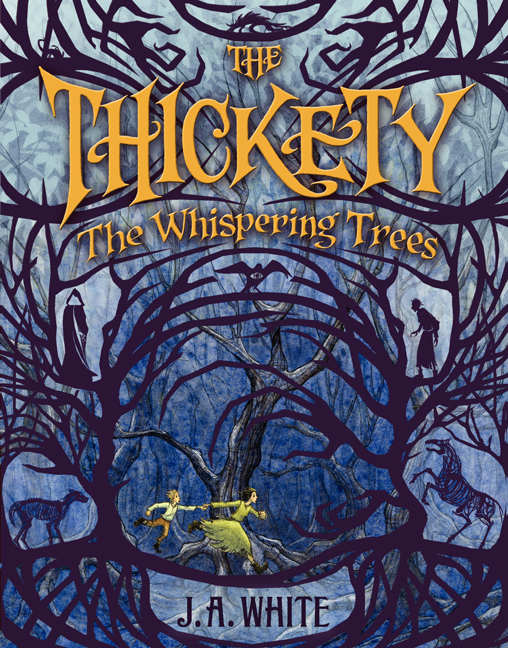
Recent Read: The Thickety: The Whispering Trees

I want to review the excellent second novel in the Thickety series, but I don’t want to spoil anything that happens in Book 1, which is a nearly impossible task. This is one of the best and most exciting new children’s fantasy series. So if you haven't, go out and get The Thickety: A Path Begins.

In The Thickety: The Whispering Trees, Kara and her little brother Taff are alone in the darkness of the Thickety, and Sordyr, the evil forest demon, is after them. They have no choice but to trust Mary Kettle, a witch infamous for the ease with which she traded children’s lives for her own magical gain. The only way out, Mary tells them, is to get past Imogen, once a girl, now more of a monster. (And I'll leave it at that, so as not to give away much of this or the last book.)

White maintains the momentum and excitement of the first book throughout the second. This one is a little more like a quest. Kara faces different challenges as she learns to use her gifts and navigate the morality of this magical world. I was constantly amazed by White’s creativity—the creatures (and magic and evils) he invents are oftentimes beyond my wildest imaginings. Once again, White concludes this portion of the story, while still opening a door to the next chapter in what will be a four-book series. I can't wait for the rest!

Sunday, January 4, 2015

Independent Reading: The Princess in Black

The Princess in Black by Shannon & Dean Hale, illustrated by LeUyen Pham

Princess Magnolia is having tea with Duchess Wigtower when her monster alarm sounds! After convincing the duchess it was only a bird she heard, Princess Magnolia trades in her frills for black and heads off to save innocent goats from a giant blue monster. Can she save the goats and keep her identity secret from the prying eyes of a nosy duchess?

In the author bio, Shannon and Dean Hale say, “Sometimes our daughters wear princess dresses and play tea party, and sometimes they don capes and fight monsters. We wanted to write a character who does both, too!” And what a fun way to do that. I loved it. It’s funny and charming and tongue-in-cheek. Her trusty steed is a black pony disguised as Frimplepants, the sparkly unicorn. When Princess Magnolia fights the monster, her acrobatics are accompanied by “princess pounce!” and “twinkle twinkle little smash!” LeUyen Pham’s illustrations are half the fun, with priceless facial expressions and funny details.  The monsters eat bath tubs and pick their noses. The action sequences pack a punch. Very fun, very funny, and pitch perfect.


Wednesday, December 31, 2014

Picture This: Tiny Creatures: The World of Microbes

Tiny Creatures: The World of Microbes by Nicola Davies, illustrated by Emily Sutton

Microbes may not sound like an appealing topic to read about in a picture book, but Nicola Davies and Emily Sutton reveal the curious world of microbes as a fascinating place.

"You know about big animals, and you know about small animals...but did you know that there are creatures so tiny that millions could fit on this ant's antenna? So tiny that we'd have to make the ant's antenna as big as a whale to show them to you?"


The author and illustrator explain concepts simply and clearly through both the text and the accompanying illustrations. They illuminate the wide variety of microbes and their various functions--from making us sick to turning rocks into soil. Who knew how interesting, relevant, and even beautiful microbes could be?

"They are the invisible transformers of our world--the tiniest lives doing some of the biggest jobs."