Pages

Showing posts with label 2012. Show all posts

Sunday, January 5, 2014

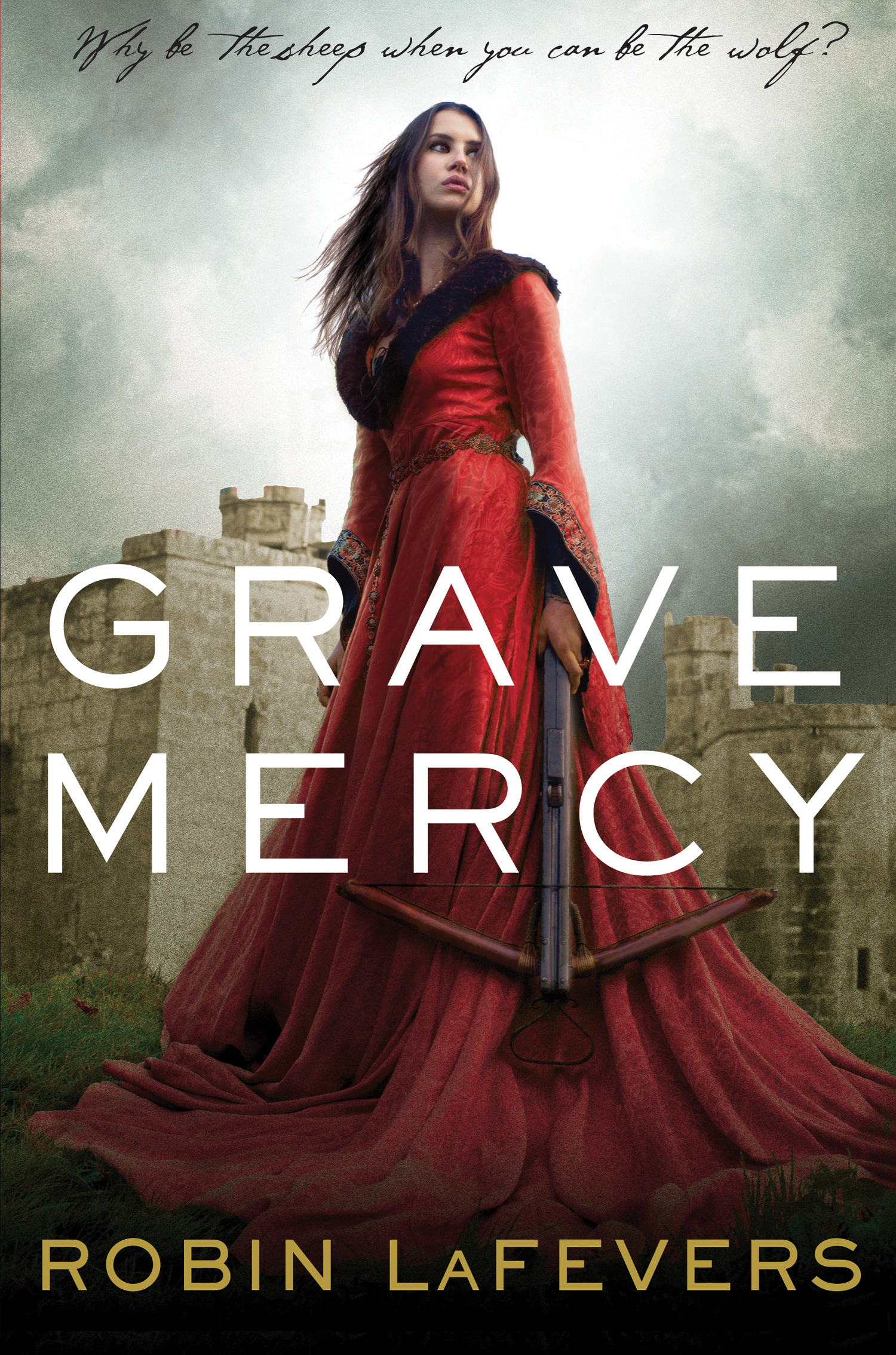
Recent Read: Grave Mercy

Ismae is rescued from a horrifying arranged marriage and delivered to the Convent of St Mortain, where she learns she is a daughter of Death himself. She is trained in the arts of deception and assassination so she can carry out His will, that is, end the lives of traitors. When she leaves on a mission to the high court of Brittany, she becomes embroiled in the politics and dangerous treachery of the nobles there. Will she be able to carry out the orders of the convent when what they see conflicts with what she herself sees?

In Grave Mercy, Robin LaFevers has written some top notch young adult fantasy. The plot and mythology were well-developed. I really liked the pagan-catholic mythology--it was interesting and unique. There was a lot of intrigue and mystery, some action, and a rather romantic romance (it hits a lot of buttons and avoids insta-love). It was an exciting page-turner. And though it’s part of a series, it is a self-contained story that works just fine as a stand alone. Thoroughly enjoyed this one.

Tuesday, April 30, 2013

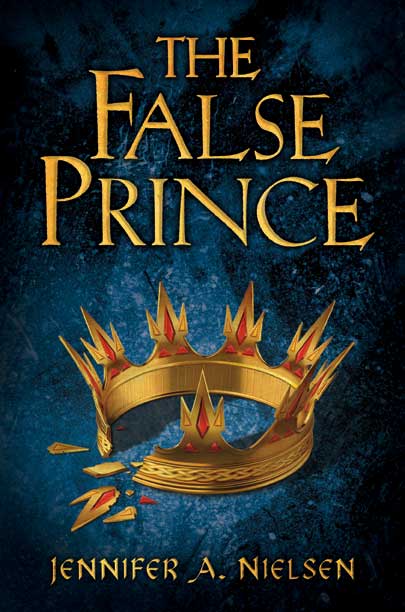
Recent Read: The False Prince

Sage, a spunky orphan, is enjoying his life of thievery, dirt, and avoiding punishment, when a nobleman named Conner plucks him out of his hardscrabble life, along with three other orphans. The cunning Conner reveals that the orphans are in a competition to impersonate the long-lost prince of Carthya. But while Sage isn't sure he wants to give up his freedom or risk committing treason, he might lose his life if he is not chosen.

The False Prince by Jennifer A. Nielsen was so good. To start, the premise is an interesting and exciting one that pulls the reader in right away. Even though it has a competing-for-your-life set up (complete with training) that's so overdone in a post-Hunger Games publishing world, I didn't realize it until now. In other words, this story comes off as original and interesting (instead of tired). I loved the characters--Sage is wonderfully defiant, clever and charming, with a strong character (despite his sometimes questionable morals). The plot and politics, as well as the relationships are complex and intriguing. This is a smart, fast-paced read I'd recommend to all readers, but especially reluctant ones.


Saturday, April 27, 2013

Recent Read: Quiet: The Power of Introverts in a World that Can't Stop Talking


Ann chose to represent introverts in the public art project One & Other, where members of the public occupied a normally vacant plinth in Trafalgar Square in London. See her entire hour here.

Quiet: The Power of Introverts in a World that Can't Stop Talking by Susan Cain

I first heard of Susan Cain when I read some of the articles she published leading up to the release of this book. I then listened/read every interview with her I could find. She was everywhere--Time Magazine, NY Times, NPR, and local papers everywhere. The book debuted at #4 on the NYTimes bestseller list.

Every time I read something of hers, like an article in the Toronto Globe & Mail entitled, "Giving Introverts Permission to Be Themselves," I found myself saying, "Yes!" and "Thank you!" I answered yes on almost every question of her introvert quiz, and was determined to be a "strong introvert."

I waited months to get the book from the library, and then only got halfway through before I had to return it so it could go to the next person. I waited for it to come out on paperback and reread the whole thing, pencil in hand to mark it up.

It feels like an exaggeration, but my instant reaction to it is that it's been life-changing. Thank you, Susan Cain. It's both validation and understanding of my personality and who I am.

Cain starts with a little history, explaining how our society transitioned from a Culture of Character to a Culture of Personality, where extroversion came to rule and become the ideal. Often citing examples of significant people in history who were introverts, she discusses introversion (and extroversion) in business, culture, child-rearing, teaching, and relationships. She delves into the science and psychology of it as well. It was fascinating, useful, illuminating.


"Introversion--along with its cousins sensitivity, seriousness, and shyness--is now a second-class personality trait, somewhere between a disappointment and a pathology. Introverts living under the Extrovert Ideal are like women in a man's world, discounted because of a trait that goes to the core of who they are. Extroversion is an enormously appealing personality style, but we've turned it into an oppressive standard to which most of us feel we must conform." 
-Susan Cain, Quiet


Also, her website is a great resource for introverts.

Saturday, April 20, 2013

Picture This: King Jack and the Dragon

King Jack and the Dragon by Peter Bently & Helen Oxenbury

King Jack and his knights spend the afternoon building a castle, and then battling to protect it from dragons and beasts. But then giants come to take away Sir Zack and Casper, leaving King Jack alone in his castle to face the creatures in the night all by himself.

This ode to make believe is sweet and funny, with a classic, old fashioned feel both in text and illustration. Bently's text rhymes wonderfully, and contains little moments of humor. Oxenbury switched between black and white sketches and full (yet muted) color.


Friday, March 29, 2013

Recent Read: The Unfortunate Son

Set in 16th century France, this story is about Luc, a boy born with only one ear. His father rejects him, as do many others who see his deformity. But when he meets a fisherman named Pons and his sister and niece, Luc is embraced and loved as part of the family. He's gifted at fishing and becomes an apprentice. But his happiness is short lived. At sea one day, a ship of pirates kidnap Luc and sell him as a slave in North Africa. Villagers think of the boy as terribly unlucky--one ear, a drunkard father, stolen by pirates--but Pons always called Luc his good-luck boy. Will Luc survive and overcome the misfortune that's befallen him, or will his life prove unlucky as the villagers say?

The Unfortunate Son by Constance Leeds was wonderful. The writing is top-notch. The historical setting is meticulously researched, and Leeds gives the reader an interesting look into 16th century France. But it's not an exciting swashbuckling tale, as the kidnapped-by-pirates part might suggest. He doesn't even get kidnapped until almost 100 pages in. That's not to say that it's boring. There's a little bit of a mystery involving Luc's parentage, there's the hope/effort to reunite Luc with his adopted fisherman family, there's the quest for survival in a new place as a slave, etc. Leeds creates meaningful relationships with fully fleshed-out characters. I became invested in these people and their stories--I didn't want to say goodbye. I also loved the themes Leeds delved into (and how she addressed them)--destiny, luck, attitude, perception, as well as forgiveness. Does Luc's ear make him lucky or unlucky? Is Luc's fortune determined by exterior circumstances or his own attitudes and decisions?
(There is a mention of eunuchs--it's for a purpose, but I would imagine that some parents would not want to explain the what and why to their children.)

Friday, March 15, 2013

Picture This: The Day Louis Got Eaten

The Day Louis Got Eaten by John Fardell

Louis and his sister Sarah are in the woods when Louis is eaten by a Gulper! Sarah goes after the Gulper to save her brother, but as soon as she's reached the Gulper, it's eaten up by a Grabular. We soon learn that there are many hungry creatures around. Will Sarah ever be able to get her brother back?

This was a fun one. The Gulper swallows Louis, a Grabular swallows the Gulper, an Undersnatch eats the Grabular, a Spiney-backed Guzzler downs the Grabular, etc. until there's a bit of a Russian doll situation. Each creature is distinct--one comes from the sky, one from the sea, one from the desert, another from the mountains, and they all look goofy rather than scary, adding to the humor. Readers can watch as Sarah turns her bike and some sticks into the various vehicles she needs to traverse these landscapes, including an underwater bike with a breathing tube that goes to the surface. Fardell uses repetition effectively, increasing the humor. The conclusion (rescue) is funny and unexpected. On a second reading, you can see that each monster is slightly visible in its approach before it's revealed. Funny, entertaining, creative, and plenty of details make for a lovable book.

from The Day Louis Got Eaten by John Fardell

from The Day Louis Got Eaten by John Fardell

from The Day Louis Got Eaten by John Fardell

Monday, March 11, 2013

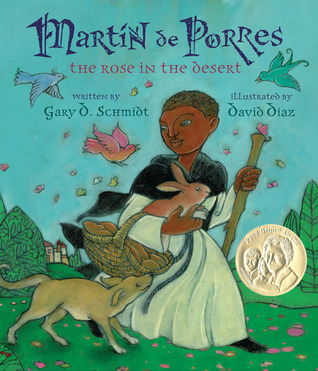
Picture This: Martin de Porres: The Rose in the Desert

Martín de Porres: The Rose in the Desert
by Gary D. Schmidt, illustrated by David Diaz

Martin de Porres grew up in the barrios of Lima, Peru. With an African slave for a mother, and a Spanish conqueror for a father, he was often disapproved of. But at the age of 8, his father retrieved Martin and his sister to be educated in Ecuador. Disapproval followed him to Ecuador and in Lima as he became apprentice to a doctor. When Martin wanted to join the Dominican Order, he was told he could never be a priest because of his impure blood. So instead, Martin offered to work as a servant. Despite the condemnation of so many, he became known for his healing abilities, his kindness, and his humility. People and animals came to be cared for by him. He was eventually welcomed into the Dominican Order, and he became known as the rose in the desert.

This book was beautiful in story, message, prose, and  illustration. It's no wonder it won the Pura Belpre Illustrator award. The story is incredible--a mulatto boy overcoming racism, class, and poverty through humility, service and goodness--all in the 1600s. Gary Schmidt has written a beautiful, poetic text to convey this story. I knew I was in for something special with the personification of hunger and illness ("Hunger lived in their home. Illness was their companion") The repetition also has a very poetic feel to it (frowning, disapproving people, the phrase "who is this strange boy"). And yet despite whatever troubles may have ailed Martin, Schmidt maintains a tone of peace and optimism.

Then there are the illustrations. So beautiful. They're rich and saturated with color. With dark outlines, and sometimes panel-like shapes, many of the illustrations have a stained-glass quality to them. A number of pages feature motifs reminiscent of illuminated manuscripts. The backgrounds are textured and weathered like frescoes or the stone walls of a church. The renditions of Martin himself depict his sensitivity and a harmony with his surroundings. Highly recommended.

I'll be adding this to my list of the best picture books of 2012.

Illustration by David Diaz, from Martin de Pores: A Rose in the Dessert

Illustration by David Diaz, from Martin de Pores: A Rose in the Dessert

Illustration by David Diaz, from Martin de Pores: A Rose in the Dessert

Wednesday, February 27, 2013

Picture This: One Special Day

One Special Day by Lola M. Schaefer, illustrated by Jessica Meserve

"A story for big brothers and sisters"

Spencer is strong as a bear, fast as a horse, and tall as a giraffe. And then, "one special day," he is gentle and quiet because he's become a brother for the very first time.

This is a simple book about welcoming a new sibling. Spencer as described as a lot of things: wild, messy, funny, tall, strong, fast, etc. And he's as ___ as a ____. An animal is used used to describe one of Spencer's characteristics. The animal is not written, but rather illustrated as seen below. I think this would be a fun book to read aloud, so kids could jump in with what Spencer is like. "He was fast--fast as a ..." "Horse!" The illustrations are very nice--bold and appealing, depicting animals and idyllic family scenes.


Giraffe!


Monday, February 18, 2013

Picture This: This Moose Belongs to Me

This Moose Belongs to Me by Oliver Jeffers

Wilfred calls his moose Marcel. He taught Marcel all the rules of being Wilfred's pet. But Marcel mostly seems to do what he wants. One day someone else claims that Marcel is her moose. That can't be. "This moose belongs to me," says Wilfred. But does it?

I love Oliver Jeffers. I love his humor (both in writing and illustrating), his funny-looking characters without feet, and his stories. Marcel is good at "providing shelter from the rain," but not so good at "going whichever way Wilfred wants to go." When a woman claims it's her moose, Rodrigo (oh, the names!), we see that Marcel may not have loyalty so much as an affinity for food. Indeed, if you look carefully at Marcel, you might notice that he doesn't care about the people around him at all--he follows apples. Wilfred leaves in a huff, trips, gets tangled in string, and ends up lying on the forest floor, unable to go home. Fortunately, Marcel comes to rescue him...sort of, and Wilfred realizes that maybe "he'd never really owned the moose anyway."

The book is illustrated with "a mishmash of oil painting onto old linotype and painted landscapes," which makes for rich and varied landscapes paired with Jeffers's signature styled people and moose. Stick-legged Wilfred wears red suspenders and a bowtie, and sports one single curly cue of hair on his baloon-shaped head. The moose is equally absurd, with a giant head, short (though somewhat variable) body, stick legs, and long, sprawling antlers whose wingspan is double the length of his body. Some scenes are depicted on a stark white background, while others feature grand vistas and beautiful mountains. I'm adding it to the honorable mentions of the year.


Notice the tag hanging off his antlers with his name on it.


Saturday, February 9, 2013

Picture This: One Cool Friend

One Cool Friend by Toni Buzzeo, illustrated by David Small

Elliot is very  proper and well-mannered--so much so that he even wears a tux. It's when he goes to the aquarium with his father that he finds the animal that best suits him: penguins. When he asks his father if he can have a penguin, his father says yes and gives him $20 to purchase a stuffed penguin. Elliot makes his way back to the penguins, climbs over the fence, wades through the water, picks up the smallest penguin, puts it in his backpack, and brings it home. But how will he care for it, and what will happen when his father finds out?

This is such a fantastic combination of illustration and text. Buzzeo has left room in her spare text for Small to fill in moments with humorous illustrations and details, maximizing the potential for laughs. With one or two lines, Buzzeo tells us everything we need to know about Elliot ("a very proper young man," his thought that the aquarium means "kids, masses of noisy kids"). Add to that Small's illustration of him standing very straight, wearing a tux, a sideways look toward the reader, with perfect placement and use of negative space (see below). The timing is just right, and there are lots of wonderful little details (I love the girl running down the hall in horror with a crab attached to her finger). There are some visual motifs that recur throughout, including the check pattern (on the walls, a suit, the floors, a bedspread, and the endpapers). And the ending is a fabulous final page surprise, that will make you realize how many details were there that you didn't even notice the first time around.


click to enlarge

Picture This: Machines Go to Work in the City

Machines Go to Work in the City by William Low

This is for all the truck/machine-loving kids out there. Low goes through a number of machines, making the sound they make, and then asking a question with the answer revealed in an opened flap. Check out the garbage truck pics below as an example.
Vroooom! Here comes the garbage truck, making its run!
When the truck makes its last pickup, are the garbage collectors done or the day?
[open flap] No, they must go tot the landfill to empty the trash.
Low goes through a train, a vacuum truck, a traffic light (which has to be repaired  with a bucket truck), a tower crane, and an airplane. At the end are diagrams of all the machines with labeled parts and explained functions. It's well done, and I think the appeal is pretty obvious (and then you can put all the machines to sleep with Goodnight Goodnight Construction Site).


Monday, February 4, 2013

Best Picture Books of 2012

Well, I'm late this year because it's taken a long time to get my hands on all the books I wanted to read before constructing a list. In fact, there are still four I'm on the waiting list for, and there are eight books not available my libraries. So there is a slight possibility that I will have to amend this list.
Here are the Top 10:

Sleep Like A Tiger
Written by Mary Logue, illustrated by Pamela Zagarenski
This is Not My Hat
By Jon Klassen
A Home for Bird
By Philip C. Stead
Creepy Carrots!
Written by Aaron Reynolds, illustrated by Peter Brown
Z is for Moose
Written by Kelly Bingham, illustrated by Paul O. Zelinsky
Each Kindness
Written by Jacqueline Woodson, illustrated by E. B. Lewis
Martin de Porres: The Rose in the Desert
By Gary D. Schmidt, illustrated by David Diaz
The Obstinate Pen
By Frank W. Dormer
Green
By Laura Vaccaro Seeger
Bear Despair
By  Gaetan Doremus

Honorable Mention:


This Moose Belongs to Me by Oliver Jeffers


Extra Yarn Written by Mac Barnett, illustrated by Jon Klassen
Step Gently Out Written by Helen Frost, photographs by Rick Lieder
One Cool Friend Written by Toni Buzzeo, illustrated by David Small

Thursday, January 24, 2013

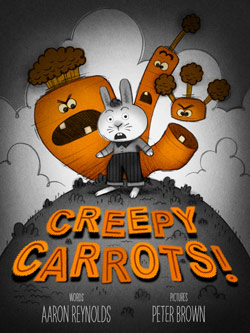
Picture This: Creepy Carrots!

Creepy Carrots! by Aaron Reynolds, illustrated by Peter Brown

Jasper Rabbit knows where all the best, crispiest, tastiest, fattest carrots are. He stops by the field all the time--morning, afternoon, evening--to munch on as many as possible. He "couldn't get enough carrots...until they started following him." He can hear them and see there shadows following him, showing up in his bathroom and bedroom, but every time he looks or calls his parents, they're gone. Whatever will he do?

This book is great fun. Inspired by the Twilight Zone and old B-movies, Brown made the very effective decision to illustrate the book in black and white pencil drawings--with the exception of the orange carrots. (...or whatever seemed like carrots a moment ago...) Brown recalls film noir and classic horror in other ways, too--like dramatic lighting, silhouettes and shadows. The hilarious and inventive story (just thinking about carrot stalkers makes me chuckle) is told with effective pacing and key pauses (such effective ellipses). And did you know that the sound of creepy carrots is "tunktunktunk"? It's easy to see the kid appeal here. I'm a fan.


priceless

Monday, January 14, 2013

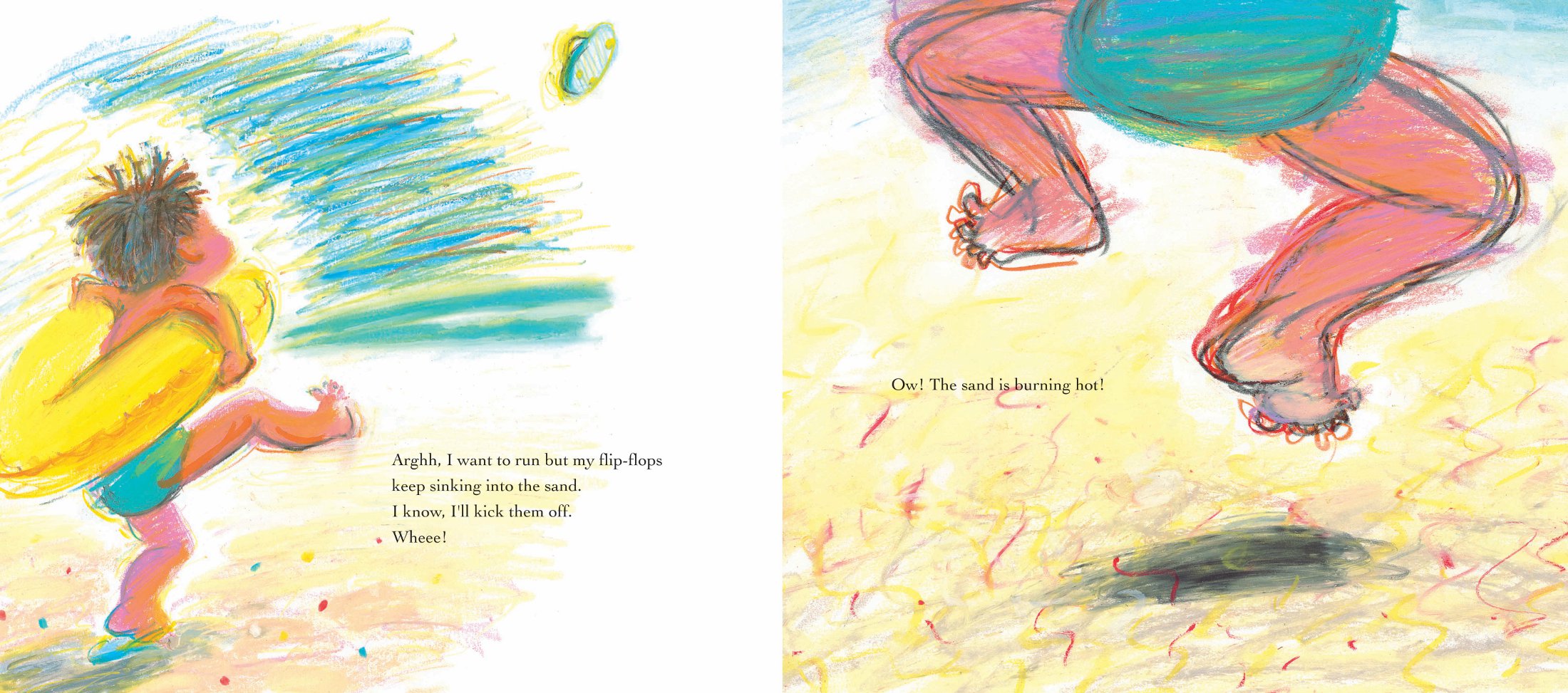
Picture This: Beach Feet

Beach Feet by Kiyomi Konagaya, illustrated by Masamitsu Saito

This is what it feels like to go to the beach, plain and simple. The salty breeze, kicking off your flip flops, running quickly as the sand burns your feet, running into the cool water to cool them off, feeling the wet sand sneak in between your toes in the water, and on and on.

This book is summer and the beach. It doesn't have a narrative, it's simply the experience of a good day at the beach, through the perspective of a child's feet. The illustrations contain a kinetic energy-- they're full of movement and excitement and life--as well as bright summer colors. It reminded me of the joy of having to run quickly to the water to cool my feet and then feeling the wet sand in between my toes. A must for summer.


Wednesday, January 9, 2013

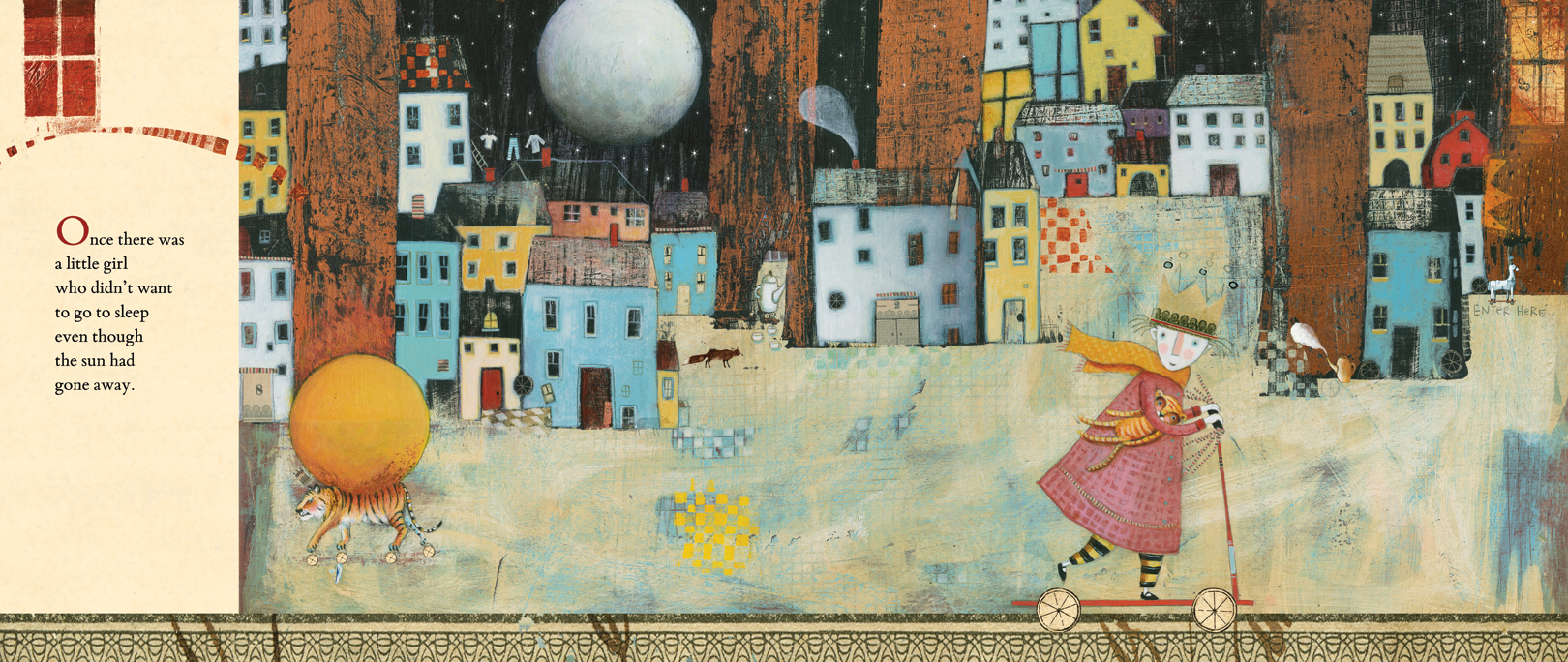
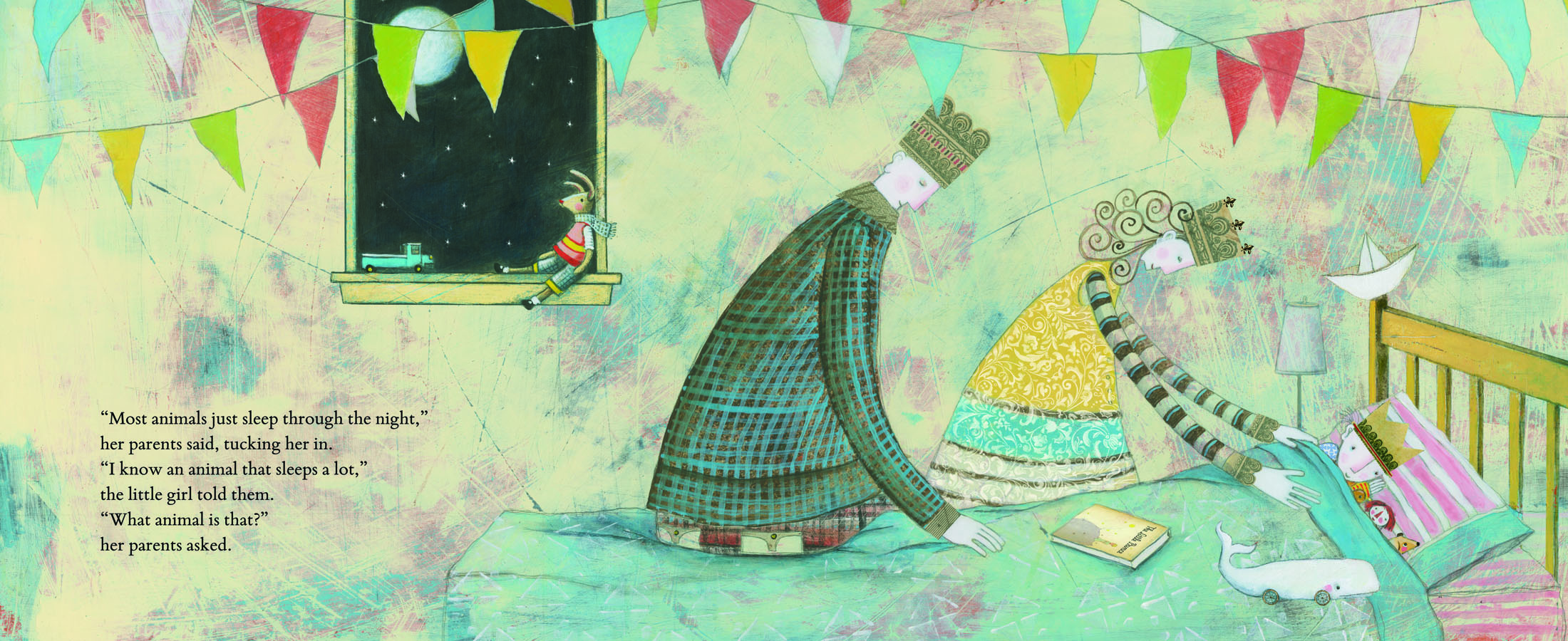
Picture This: Sleep Like a Tiger

Sleep Like A Tiger by Mary Logue, illustrated by Pamela Zagarenski

One evening after the sun has gone down, a little girl doesn't want to go to bed. She tells her parents that she's not sleepy or tired at all. Her parents tell her that even though she doesn't have to go to bed, she does need to put on her pajamas, wash her face and brush her teeth. Once under the covers, she asks her parents, "Does everything in the world go to sleep?" Her parents go through a number of animals, explaining when and where and how they go to sleep. After thinking about all those sleeping animals, the little girl may not be able to stay awake as she had planned.

It may not sound remarkable (I fear my summary/intro is inadequate), but this is one of my favorite picture books of 2012. It's a wonderful combination of an eloquent text, a lovely story, and whimsical illustrations. In this text, Logue captures childlike persistence, curiosity, and imagination. Throughout is creative imagery (snails "curl up like a cinnamon roll inside their shell"), with occasional moments of humor. The selection of sleeping animals are interesting (she found animals that sleep in different ways) and at just the right amount. And then, after the little girl's parents have given her permission to stay awake all night long, she thinks about how she and her sleep are like the animals and their unique ways of sleeping. It's a story that flows and all ties together so nicely at the end. This is truly excellent picture book writing.

Then there are the illustrations. They're rich with detail--charming animal toys and patterned fabrics, bright flags, and textured backgrounds. I can see children loving to look at these pages again and again, each time spotting something new (like the alarm clock and teacup in the bear's den). They're slightly surreal, giving the book a dreamy, whimsical feel, which suits the imaginative, sleepy story. Even the end-papers are wonderful (at the end you can see the family asleep through the windows (including the dog!). As the announcement of the Caldecott fast approaches, I'm rooting for this one.

click to enlarge

click to enlarge