Tricky Vic: The Impossibly True Story of the Man Who Sold the Eiffel Tower by Greg Pizzoli
“In 1890, the man who would one day be known by forty-five different aliases was born to the Miller family, in what is now the Czech Republic. His parents named him Robert.”
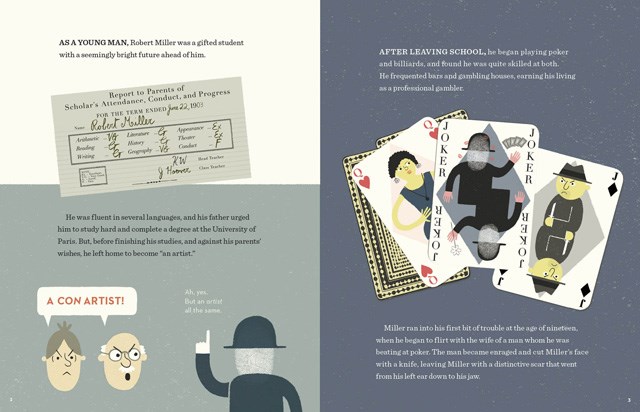
So begins the tale of ultimate con man Tricky Vic (often known as Count Victor Lustig). He was a good student, but before finishing his studies at the University of Paris, he left to pursue a life of deception. His exploits include posing as a count in order to cozy up to rich ocean liner passengers and rob them at the dock, conning Al Capone into thinking he was an honest man, convincing men to buy his money making machine, and, of course, selling a contract for the rights to the Eiffel Tower and its scrap metal. This is a fascinating tale about a liar for the ages.
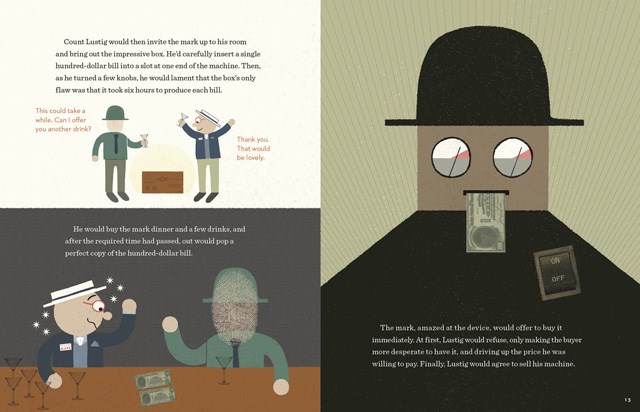
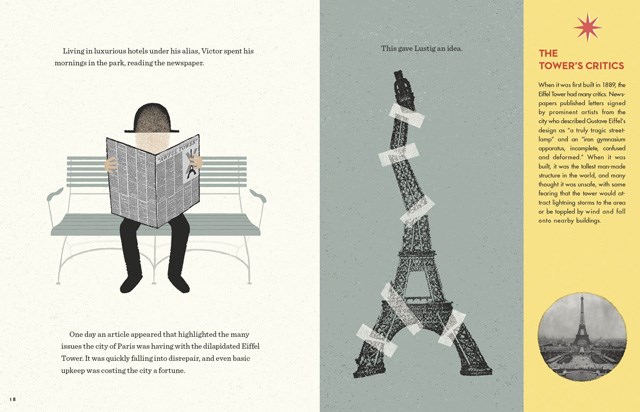
I think one of the many things that sets this book apart is that it’s a biography for children about a bad guy. No didacticism or heroism to be found, just one unbelievable tale after another, always interesting. Pizzoli’s design-heavy, graphic mixed media illustrations complement the story. He cleverly represents Tricky Vic’s face as a fingerprint, and draws on archival photographs and newspaper articles, as well as his own photographs to create textures and shapes. If you look at this post on him and this book at Seven Impossible Things Before Breakfast you can see all the wonderful details he put into the book, some of them almost like secret references to Paris. (that texture? Comes from the floor of the Eiffel tower) He includes the occasional sidebar explaining such things as prohibition, this particular part of the Eiffel Tower’s history, and counterfeiting to provide a little more context and historical background for young readers. Very well done all around.
Wednesday, April 15, 2015
Picture This: The Crocodile Who Didn't Like Water
The Crocodile Who Didn't Like Water by Gemma Marino
"Once upon a time, there was a little crocodile. And this little crocodile didn't like water."
Indeed he looks on wistfully as his brothers and sisters play in the bathtub, in the lake and in the pool. He buys an inner tube (swim ring in the book b/c it's British) with saved tooth fairy money, bound and determined to swim and have fun with the others. But it doesn't work out. He definitely hates water.
Such a fun story. When little crocodile sneezes out fire, he and everyone else realize something--he's not a crocodile. Little dragon, once he figures out who he is, is much happier and can share his gifts with his crocodile siblings. When I read the story a second time, I noticed all sorts of things I didn’t notice before (indicators of little dragon’s true identity). Even the endpapers tell a part of the story. I loved Marino’s illustrations—the style, textures, and expressiveness of her little reptiles. This one is a winner!
"Once upon a time, there was a little crocodile. And this little crocodile didn't like water."
Indeed he looks on wistfully as his brothers and sisters play in the bathtub, in the lake and in the pool. He buys an inner tube (swim ring in the book b/c it's British) with saved tooth fairy money, bound and determined to swim and have fun with the others. But it doesn't work out. He definitely hates water.
Such a fun story. When little crocodile sneezes out fire, he and everyone else realize something--he's not a crocodile. Little dragon, once he figures out who he is, is much happier and can share his gifts with his crocodile siblings. When I read the story a second time, I noticed all sorts of things I didn’t notice before (indicators of little dragon’s true identity). Even the endpapers tell a part of the story. I loved Marino’s illustrations—the style, textures, and expressiveness of her little reptiles. This one is a winner!
Subscribe to:
Posts (Atom)