
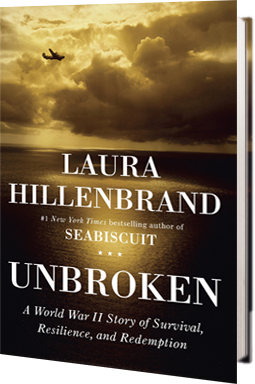
As if we needed any more proof of Laura Hillenbrand's brilliance (if you haven't read Seabiscuit, I highly recommend it), here is her second book, about a childhood trouble maker, turned Olympic runner, turned World War II bomber, turned POW in the Pacific. It's an incredible story. It's been on the NY Times Bestseller list for close to 90 weeks--and with good reason.
Hillenbrand is a very skilled writer. She's a storyteller, and she knows how to spot the kind of details that will not only bring people and stories to life, but also present a bigger picture. She weaves together narrative, events, facts and background info, with heart-pounding scenes of suspense. At one point, I remember my dad and I were sitting at the table reading--he was reading Hunger Games, I was reading Unbroken--and as I breathlessly reached the end of the chapter, I thought, "this is as harrowing and exciting as Hunger Games, except it's real!" I dare you to read the preface, a short 2 pages, and not find yourself hooked.
We meet Louis Zamperini as a clever, thieving child, introduced to running by his brother to keep him out of trouble. It's not long before he's winning all his races, going to USC on scholarship, and becoming one of the most beloved runners of his time. He went to the Olympics in Berlin, rubbed shoulders with Jesse Owens, and stayed in the lovely Olympic Village that would become army barracks. His determination, resourcefulness, and good nature would serve him well as he entered the war.
I learned so much about World War II that I hadn't known. Hillenbrand shares many untold stories of the war--especially pertaining to war in the Pacific. The Pacific presented different challenges. With all that wide open ocean, equipment and planes had to be different, battle strategies were different, survival was different (soldiers had to face shark infested waters and the possibility of never being found if they went down). And then there was what it meant to be at war with Japan.
Often we focus on Europe, the Nazis, and the Holocaust. What happened to the Jews (and many, many others) was atrocious. But there were lots of atrocious things happening in the Pacific as well. The Japanese held similar values to the Nazis--only the Japanese thought they were the supreme race. This sort of attitude made it easy for them to invade other Asian countries (Korea, Indonesia, China, Philippines, etc) and force their civilians into slave labor (and sex slavery). Japan actually set up a puppet state in Manchuria in 1931, and invaded the rest of China in 1937, two years before Germany invaded Poland.
Honor and shame were paramount in Japanese culture. The Japanese military believed it was better to die than suffer the unbearable shame of being captured, a philosophy which informed many aspects of the war in the Pacific. It affected the way they fought the war (kamikazes, for example), their attitude toward captured POWs, their eventual surrender, and their policies (like "kill-all" orders that were to be carried out before capture). I read in horror of the cruelty POWs suffered at the hands of some guards. 37% of (recorded) American POWs died in Japan, as opposed to 1% who died in Germany.
And then the war ended, and the POWs got to go home, but tragically, that wasn't the end. Their torture followed them home in the form of PTSD's dreams and flashbacks. Many suffered lasting physical effects, and others were consumed by hatred, resentment, or desire for revenge. And yet, men were able to move on and build happy, successful lives for themselves and their families. It's truly inspiring.
I hope I haven't spoiled too much. Some of what's in this book struck me so hard. There's so much I'm bursting to share, but I tried to keep it brief in the hope that you'll read about it yourselves and have your own moments of of shock, understanding, inspiration, etc. I've tried to speak in generalities, so as not to spoil the main stories of the book. Louie Zamperini is one of a kind. As it says on the cover, his is a story survival (against all odds, I might add), resilience, redemption. I laughed, I cried, I stared in disbelief. Just wait until you get to the end. I cannot recommend this book enough.
I've included images of that preface in the hopes of hooking you, too. (you can also find these pages in Amazon's "Look Inside!" feature)
 |
| enlarge |
 |
| enlarge |

No comments:
Post a Comment