Pages

Monday, April 28, 2014

Recent Read: Don't Even Think About It

Don't Even Think About It by Sarah Mlynowski

Homeroom 10B goes to the nurse to all get flu shots. They come out being able to hear other people’s thoughts.

This is as about as fluffy as it sounds, but boy was it fun. It was silly, immature, funny, gossip-filled, and entertaining. Mlynowski did a good job of portraying teens and their everyday dramas (sometimes serious, sometimes trivial). She also explored most, if not all, aspects of this telepathy side effect—both good and bad. I figure a lot of teens wish they could hear others’ thoughts at some point (I did), but Mlynowski shows readers the pros and cons, as well as the ethical dilemmas telepathy entails. So actually there’s a little bit of substance (themes include privacy, honesty, gossip, ethics, friendship, etc), but handled in such a way that you hardly realize it.

Monday, April 21, 2014


"Shai's Uncle Won had taught her that being bested was a rule of life. No matter how good you were, someone was better. Live by that knowledge, and you would never grow so confident that you became sloppy."

-Brandon Sanderson, The Emperor's Soul


Friday, April 18, 2014

North Korea

Nothing to Envy begins with an image of North Korea by satellite at night. 23 million people live there, but at night, while South Korea glows, North Korea is in total darkness.

      
I just finished reading Nothing to Envy by Barbara Demick.

In the course of reading Nothing to Envy, I learned about the portraits of Kim Il Sung that were given to each household with a white cloth to be used solely to clean those portraits on a daily basis. (Inspections were held at random) I learned about new buildings with elevator shafts, but no elevators. I learned about a hospital with no electricity because it had been diverted to illuminate a statue of Kim Il Sung. I learned about the starvation that got so bad that people would inspect animal feces for undigested corn kernels.

As I was about to pick up yet another (:::cough::: silly) YA dystopia, I thought it was time to read about a real dystopia that exists today. Author Barbara Demick was the LA Times correspondent for Asia, and is now the bureau chief for Korea. She lived in South Korea and decided to write the book after interviewing a number of North Koreans. North Korea is a fascinating and horrifying place. To put it briefly, Kim Il Sung seized power after World War II, and turned the country into a totalitarian communist state. One of the unique things about the North Korean brand of totalitarian communism is that Kim Il Sung set himself up not just as a leader, but as God, Beloved Father, harnessing the power of faith and religion to sustain his power. In the 80s and 90s, the countries that had been propping North Korea up cut off their support. The money ran out, the economy tanked, food, electricity, and work all disappeared. Millions died.

Demick tells us the story of North Korea by sharing the personal stories of six North Korean defectors (“ordinary” people) and their families. She starts with a love story—two young people meeting in secret during the black of night (no electricity, you know) to walk and talk. Other stories include that of a mother completely devoted to the Supreme Leader, eager to do her part. Another is a doctor, who watches as her medical knowledge becomes less and less useful as supplies, electricity, facilities and medicine are lost.

The book is very well researched and informative. But it’s also personal—we see and feel something of what these people faced—both the good and the bad. We see their everyday lives as well as the tragedies they faced. It read like a novel, and I was totally invested. It’s difficult to fathom a place like this. I could on and on about all I learned--it's so interesting. And yet there's so much more I want to know.

Though this is a book of heart-wrenching tragedy, I found inspiring moments as I read about the absolutely incredible ingenuity of humanity and their will to survive. Some of it is simply a matter of carrying on from day to day, but even that is a feat in those conditions. It seems miraculous that so many people actually did manage to survive. Never have I encountered something that inspired so much gratitude in me for everyday things I take for granted.

I cannot recommend this book enough. Put down the dystopia and read about the reality that still exists, against all odds.

Photograph by David Guttenfelder. At dawn, portraits of Kim Il Sung and his son Kim Jong Il are still lit up in Pyongyang. Even during the city’s blackouts, electricity is reserved to light the flame atop Juche Tower.
David Guttenfelder is one of those rare photographers who’s been allowed into North Korea. His work is eye-opening and informative as well as artistic and often beautiful. He, too, was featured in National Geographic’s Photography Issue (October 2013). To see more try National Geographic here and here, The Atlantic, The Daily Beast, Time. Listen to him talk about his work here.

Photograph by David Guttenfelder. Members of one of the world’s largest militaries, over a million strong, pack a stadium in Pyongyang in 2012 during celebrations honoring North Korea’s first leader, Kim Il Sung.
An illustration of a building project hangs in front of the construction project in progress in Pyongyang, North Korea, photographed on April 13, 2011. (AP Photo/David Guttenfelder)
Children look through a subway car window in Pyongyang, North Korea, on March 10, 2011. (AP Photo/David Guttenfelder)
A person on a bicycle rides by as a man plows a field outside of Kaesong, North Korea, on April 17, 2011. North Korea's perennial food shortage has reached a crisis point in 2011, aid workers say, because of torrential rains, the coldest winter in 60 years and rising food prices. (AP Photo/David Guttenfelder)
A woman looks up at the end of a opening ceremony for a statue unveiling at Mansu Hill in April 2012. The sky was smoke-filled after fireworks were lit. Photograph by David Guttenfelder, AP
A view of central Pyongyang, North Korea, at dusk on April 12, 2011. (AP Photo/David Guttenfelder)
Also, if you're interested, there's a National Geographic documentary: Inside North Korea. It's really something to see video footage from inside.

Saturday, April 5, 2014

Picture This: The Bear's Song

The Bear's Song by Benjamin Chaud

Instead of going to sleep with Papa Bear for the winter, Little Bear gets distracted, and starts following a buzzing bee. Papa Bear wakes and goes chasing after his Little Bear. He chases him through the forest and the city and into the opera house, where he thinks about contributing his own song to performance...

I loved this. It will definitely be added to the best of 2013 post. It's a little like Where's Waldo, in that many pages are busy and buzzing with activity. Can you find Little Bear and the bee he's chasing in the midst of all that's happening? There is so much to look at in each spread. There's a yellow scene of animals in the forest (many of them runnign in terror from Papa Bear). In the city, the color scheme goes to beige and black with pops of color her and there. Obviously French buildings and streets are packed with people doing everything from listening to music on a device to hanging pictures to couples on mopeds across balconies. There is so much to look at. As Little Bear follows the bee into the Opera House and backstage, there's wonderful cross-section of the theatre. Not every page is busy. Chaud is very good about pacing and space, using the busyness and empty space to maximum effect.

Of course where does Papa Bear end up? Hanging from the chandelier above the two opera singers performing on stage. When the chendelier drops and he finds himself center stage, he does what anyone would do--he sings...with hilarious results. And it's all so wonderfully French.


Monday, March 24, 2014

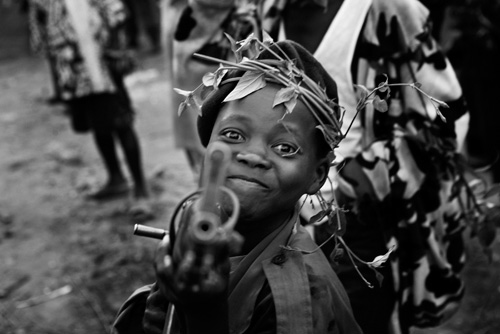
Photographer Spotlight: Marcus Bleasdale


Photo by Marcus Bleasdale, from an article in Newsweek

I just went to the Annenberg Space for Photography's exhibit: The Power of Photography, celebrating 125 years of National Geographic photography. This photo certainly demonstrates the power of photography. My jaw dropped when I saw it. Marcus Bleasdale is a documentary photographer who uses his photographs to advocate for human rights. He has spent a great deal of time in Congo documenting the conflict and the mines that fund rebels. Rebel groups recruit children for their armies and their mines.

While blood diamonds have gotten a lot attention, other minerals come from conflict mines--gold, tungsten, tantalum, tin. These are the kinds of minerals used not just in jewelry, but in computers, cell phones, and other electronics. In 2010 the Dodd-Frank financial-reform bill "called for publicly listed American companies to disclose whether any of their products included minerals from mines controlled by armed groups in or around Congo." Read more (and see more photos) in this article from National Geographic. Said Marcus about Congo:
"A report in 2004 said that more than four million people had died in what is now called Africa's first world war, and I just couldn't believe that no one was talking about this horrific death toll. That enraged me." 
"A boy waits his turn for spoonfuls of rice and beans in Pluto." Photo by Marcus Bleasdale
A child at work in a militia-run mine in Watsa. Photo by Marcus Bleasdale.
The thing about his photos is how beautiful they can be despite the (ugly implications of the) subject matter. The photo below--I could look at it for hours. It's as if it were a carefully composed painting.
Workers rip the earth apart in search of gold. Photo by Marcus Bleasdale.

Saturday, March 8, 2014

Recent Read: Paper Valentine

A serial killer is murdering middle school girls the quiet city of Ludlow. But that’s not the only thing on Hannah’s mind. She’s being haunted by her best friend who died six months ago.

Paper Valentine by Brenna Yovanoff was a great read. It immediately got me interested—she’s haunted by the ghost of her best friend? And her best friend essentially starved herself to death over a period of years? And there’s a murderer in town? I was intrigued and invested in just a few pages. Much of that is thanks to Yovanoff’s writing and the talent she has for giving you a lot of meaning and information in few words.

The mystery drives the plot, building slowly to a nail-biting climax. But equally, if not more, intriguing is the relationship between Hannah and her dead best friend, Lillian. Existing as the worst version of herself, Lillian follows Hannah around, making it impossible for her to move on or find out who she is without Lillian. Meanwhile, Hannah finds herself drawn to one the local delinquents, who she trusts more and more, even as she wonders if he could be behind the murders. As Hannah navigates through a world of ghosts, and absent best friends, romantic delinquents, and cruel murders she starts to learn more about who she is and what she’s made of. This one is fast, page-turning, eerie, and satisfying. And how 'bout that cover?